Showing posts with label Volkswagen. Show all posts

Saturday, November 24, 2012

Volkswagen L1 Concept, 2009


  • Volkswagen L1 Concept, 2009

One of a unique Car in the world today is Volkswagen L1. It weighs just 380 kilograms a carbon fibre reinforced plastic (CFRP) body. The two-seater is powered by a new common rail turbo-diesel (two-cylinder TDI) and an electric motor. With its average fuel consumption of 1.49 litres diesel per 100 kilometres, this fully road-ready and extremely aerodynamic L1 (Cd 0.195!) is advancing to become the most fuel-efficient hybrid automobile in the world. CO2 emissions of the 160 km/h fast concept car are just 39 g/km.

Drivetrain

The TDI, E-motor and 7-speed DSG are located at the rear, and they combine to create the most fuel efficient road-legal car hybrid drive in the world. Proof of this are its 1.38 litre per 100 kilometres fuel consumption and 36 g/km CO2 emissions. Serving as the primary drive source is a completely redeveloped two-cylinder turbo-diesel with common rail direct injection (TDI). It is operated in two different modes depending on the load conditions. In the standard "ECO" mode, the 800 cm3 TDI develops a power of 20 kW / 27 PS (at 4,000 rpm); in "Sport" mode - used to reach top speed, for example - the car's power rises to 29 kW / 39 PS (at 4,000 rpm). The TDI's maximum torque is 100 Newton-meter (at 1,900 rpm). Naturally, the Volkswagen L1 also has a Stop-Start system that automatically shuts down the engine when vehicle has stopped and restarts when the accelerator or E-pedal is pressed.

Tuesday, July 24, 2012

Volkswagen BlueSport Concept, 2009


  •  Volkswagen BlueSport Concept, 2009

The Maximum driving fun with minimal fuel consumption - This is the standard by which Volkswagen is starting the new car year 2009. The BlueSport proves to be a compact and passionate car with a clear Volkswagen signature. The car offers pure dynamics with a powerful 180 PS Clean Diesel engine that is combined with the characteristic Volkswagen philosophy of efficiency.

The Volkswagen BlueSport Concept is making its appearance at the car show in Detroit with a Flex Silver exterior and orange fabric convertible top. Its styling is clear and is reduced to the essentials; the car body itself has a lean and linear structure", explains Volkswagen chief designer Walter de Silva. The interior shows finesse in details and conveys a high level of technological fascination. Immediately visible to the eye is the intuitive and easy to operate touchscreen. Perfectly adapted to the interior are the leather upholstered seats in lightweight construction with their single-piece seatbacks.

Behind the two sport seats of the 3.99 meter long Volkswagen BlueSport Concept, a 132 kW / 180 PS strong Clean Diesel (TDI) with common rail injection and downstream NOx storage catalytic converter delivers dynamic performance. A 6-speed DSG dual clutch transmission - the most economical and agile transmission system in the world - transfers power to the rear wheels. In just 6.6 seconds the sports car is moving at 100 km/h; its top speed is 226 km/h. Also having a positive impact on the car's low fuel consumption of just 4.3 l/100 km and reduced emissions are two technologies that are part of the so-called Eco mode: an automatic start-stop system and energy regeneration. Together they propel the Volkswagen BlueSport Concept to an additional fuel savings of up to 0.2 liter per 100 kilometers in city driving.

Tuesday, May 22, 2012

Volkswagen Scirocco Studie R Concept, 2008


  •  Volkswagen Scirocco Studie R Concept, 2008

It's a triumphant drive: in May 2008, three VW Scirocco GT24 cars lined up at the start of the 24-hour endurance race on the Nürburgring track. At the wheel: driving legends the likes of Hans-Joachim Stuck and Carlos Sainz. The teams drove two 238 kW / 325 PS strong race cars to a dual victory at the finish line, first and second in their class. Now Volkswagen is presenting a street version of the race car at the 2008 Bologna Motor Show: the Volkswagen Scirocco Studie R Concept. A genuine Grand Tourismo with a 198 kW / 270 PS engine that delivers aggressive propulsive power. This power is distributed by a 6-speed dual clutch transmission. Adapted directly from car racing are the coilovers, the four-piston brake calipers and a sound-optimized exhaust system with its oval, polished tailpipes.

In many respects the concept emulates the race car version. Take the front end, for example: here the design adheres to the motto "Form follows function"; it features three large air inlet openings that guarantee optimal cooling of the brakes and engine. The front splitter that was added minimizes aerodynamic lift of the front axle. Also adopted from the racing version is the engine hood with its auxiliary air vents.

The rear end is dominated by an integrated rear wing and distinctive diffuser in the lower section of the bumper. These two components reduce lift at the rear axle substantially. Despite the aerodynamic design derived from car racing, a clear stylistic resemblance to the production Scirocco was preserved. Identifying characteristics of its side profile are the new side skirts and polished 19-inch alloy wheels with five sets of triple spokes. The wheels were specially developed for the Volkswagen Scirocco Studie R.
 
The radiator screen, diffuser and underside of the rear spoiler are treated in high-gloss black, and this provides a strong contrast to the white exterior paint. Supplemented by a "Bologna 08" badge, red and green stylistic elements on a white background create an Italian tricolor. The outside mirrors are also coordinated with this color scheme.

The Interior
Italy's national colors are also represented in the interior. White and black create the basic theme, similar to the exterior color of the Volkswagen Scirocco Studie R. The seams of the Recaro racing shell seats, steering wheel, front armrest, gearshift lever trim and floor mat edging are designed in the colors of the tricolor. Inside, nappa leather in "Deep black" and "Berry white" is applied to the uncompromisingly designed racing shell seat. The shell seats are upholstered with a deep black leather in carbon look. An eye-catching feature here is the conspicuous yet refined contrast of low and high-gloss elements of the carbon structure. Interior accents also consist of genuine carbon composites. The footwell features aluminum pedals specially designed for this vehicle.

Saturday, May 19, 2012

Volkswagen New Beetle Ragster Concept, 2005


Volkswagen New Beetle Ragster Concept, 2005

It's supposed to be a preview of the future design of the New Beetle. The base of the Ragster (a ragster is the cross between a ragtop and a speedster) was a regular New Beetle Convertible. 
 
It made some changes, such as chopping the top, penning a new U-shaped roof, and creating a unique paint job with silver double stripes. 
The interior differs from the original New Beetle, being a 2+2 and having distinctive control dials. Another item of interest is that the Ragster's rear-view mirror is mounted on its dashboard (a retro feature, reminiscent of the first Type 1s). The Ragster's profile is lower than that of the prior New Beetle.


Tuesday, May 1, 2012

Volkswagen Up Concept, 2007


  • Volkswagen Up Concept, 2007

There are cars that endure for all times. They are icons of their type, masterpieces of craftsmanship and technology; they put ideas into motion, make progress tangible and sometimes quite simply make everyday life better, more practical and enjoyable. Many of these cars carry the VW logo. "Bug, Beetle, New Beetle", "T1, Bulli, Samba bus, California", "Golf, GTI". Now Volkswagen is presenting - as a world premiere at the International Motor Show (IAA) in Frankfurt - a concept car that once again has the right stuff needed to move more than just one generation. It is a small, pure and high-spirited Volkswagen that pays tribute to its environment. The overall concept is marked by an innovative, clear, intuitive functionality. The name of the concept car: up! - a positive name that is a synonym for departure, activity, dynamics and the future. "For Volkswagen", says Dr. Ulrich Hackenberg, Board Member with Responsibility for Technical Development, "the response of IAA visitors will be a decisive test to determine whether the concept has the same kind of potential possessed by the Beetle at one time or by the Golf today."

The Concept
The up! is a city specialist, a car for four persons and all languages, for the job, the university, the drive to the beach and the excursion outside the city gates. A small car that shows a lot of size, because it offers more space than any other car of similar length (3.45 meters) and width (1.63 meters). Its engine - conceivable here are all facets of technology that can be sensibly applied - will run in the rear. And that changes everything: Space, mood and design.Walter de Silva, Chief Designer of the Volkswagen group, sums it up like this: "The up! is not a car whose form will become obsolete within a very brief period of time. It shines in its cleverness and yet is made with loving care. And so the up! is a clear and strong statement for future Volkswagen design." Furthermore, the team of designers and engineers has envisioned the up! concept car as the first member of an entire model line; other facets are entirely conceivable.

Ralf-Gerhard Willner, Director of Concept Development, has final responsibility for the technical layout of the up! He and Walter de Silva had already achieved a new balance in the mutual interaction between form and function at Volkswagen before the start of the project. "Absolute harmony of the basic technological concept and the emotional aspects of the design", note Willner and de Silva in unison, "can only be achieved in a hard clash of ideas between engineers and designers. That is the only way to produce icons." That is precisely why the up! is not your run-of-the-mill, small, tightly packed car, but instead is a clever, innovative whole. Its form is pure. It just had to look like this, no other look would do. There is nothing superf luous, and its functionality - and so also its design - speak for themselves. Simultaneously - and this is typical of Volkswagen - uncompromisingly attention was given to refining every line and every surface until we had created a friendly and masterful car.

The Exterior design
The fact that the engine of the up! runs in the rear has a decisive inf luence on its exterior design. That is because the up! has no classic radiator grille. It forges links to the Beetle. This fact alone gives it a great deal of independence. Dominant design characteristics are the headlamps that take an inward and diagonal line, between them the horizontally arranged air vents, the VW logo (as one of the few details kept in chrome), the tailgate that extends far forward and the smooth bumper with a circumferential black stripe as a detail of the "happy face" that is typical of Volkswagen.

In many areas, technology and design have melded into a vehicle architecture that is not only appealing, but is also very utilitarian. The rear end of the up! is a good example of this. The tailgate was produced using a transparent material. Under this gate developers also integrated the high layout of the taillights. Another feature that is technically and visually new is the location of the VW logo in the tailgate; it is also located behind glass and illuminates when the light is on. The rear bumper was designed to match the "happy face" in front.

The powerful appearance of the up!, despite all of its compactness, is emphasized by a very wide track width (1.42 meters) relative to vehicle width. The wheels are flush with the sporty outboard wheel arches and side skirts. The radial design of the wheels and surfaces extending right up to the edge of the rim make the 18-inch wheels appear significantly larger than they actually are.

The wheels that are arranged far outboard in the bumper areas reduce body overhangs to a minimum. All of these features are part of an unmistakable side profile with a very long roof arch as well as clear and large surfaces. Giving shape to its style here are the large doors and the lateral window surfaces, which incline sharply upward at the height of the rear wheel arch and thereby help to form the very independent C-pillar design.

The interior design
Mounting the engine in the rear opened up entirely new interior concepts. Relative to its exterior size, the space offering is exceptionally forward-thinking. The same is true of its variability: Except for the driver's seat, all other seats can be folded and removed. Since they are designed as light shells, they can be quickly stowed in one of the cargo areas - besides the front trunk there is also one in the rear - to free up space. Afterwards, the entire passenger compartment length can be utilized as a storage area for especially bulky objects.

To achieve the high level of seating comfort that is usual at Volkswagen, besides their ergonomic design, in the case of the up! this level of comfort is also attained by a simple yet very effective trick: Similar to a self-inf lating air mattress, air can be sucked out of the seat surfaces via a valve. This means that the seats can be adjusted 1:1 to the body anatomies of the occupants who have just
taken a seat.

Intuitive controls
On its up! concept car, Volkswagen is presenting some completely new solutions when it comes to operator controls. Klaus Bischoff, Chief Designer for the Volkswagen Brand, comments on this: "Another reason the up! is so fascinating is because everything, every detail, was thought out anew. In the interior we have a touchscreen with new proximity sensor technology for controlling the navigation, radio, trip computer and climate control systems. It is operated absolutely intuitively. As a result, the most complicated functions can be controlled like child's play."

The up! has two central displays. In the cockpit, a 8-inch monitor shows the driver key information such as vehicle speed, fuel level and range, as well as momentary CO2 emissions.

In the center of the instruments - equally easy for driver and front passenger to see and control - an 7-inch monitor shows the way that future human-machine interfaces will look and operate. Here all conceivable functions can be controlled via the mentioned touchscreen, which also reacts via proximity sensor to gestures, i.e. specific hand movements.

Menuing was restocked and reorganized so that people without computer science educations would be able to operate the system. The developers intentionally separated "display" and "control" levels from one another. Always shown on the screen is a control bar with standard functions such as climate control or audio volume control. Developers packaged functions of other higher-order systems - navigation, telephone, radio, images, movies, etc. - on a display level that has been referred to internally as the "main menu carousel" - a type of virtual carousel. It consists of the icons of different system functions (telephone, navigation, etc.). When the user touches the "main menu carousel" it can be rotated by touchscreen. Visually, this control is just as spectacular as it is intuitive. When the desired function appears on the main menu carousel - such as the telephone - all the user needs to do is move his or her hand to the display to switch over to the telephone menu, thanks to proximity sensor technology. The new type of user control is fun, easy to understand in any cultural environment and very safe. That is precisely what is typical of Volkswagen.

Thursday, April 19, 2012

Volkswagen Derby, 1979


Volkswagen Derby, 1979

The Mk I Polo, are badged version of the Audi 50, was introduced in 1975. The differences between the Audi and VW models were minor, with the Polo being cheaper and much more basic. The two cars were initially sold along side each other, however the Audi 50 never sold as well, and was withdrawn in 1978. The Polo was manufactured at the Volkswagen plant in Wolfsburg. In 1977, the Derby sedan was released, which was simply a Polo, identical to the hatchback from the C-pillar forward, with a large boot attached (an old Audi proposal, but never sold by this brand).

When first on sale the range topping car, the LS model, featured the 50 PS (37 kW) 1043 cc engine found in the Audi 50. Other specifications included parking lights, rear wash wipe, sun visors, chromed bumpers and 4.5J X 13" wheels. The N model was the basic starting spec lacking many of the features of the LS. In 1979 the GLS was introduced, replacing the LS as the range-topping car; specification upgrades included chrome headlight and grill surrounds, sunroof, a cigarette lighter and chrome wheel trims.

895 cc, 1093 cc and 1272 cc engines were used, with the smaller one used only in the Polo hatchback, and the 1272 cc only in the Derby, Audi 50, and the rare Polo GT. Different levels of compression were used on each size to achieve different power outputs, and the variations are numerous, often differing depending on the country of sale, ranging from 35 to 60 PS (26 to 44 kW).

Mk IF (1979-1981)

The Mk I Polo and Derby were facelifted in 1979 (Mk IF) with plastic bumpers, a different front grille and a revised dashboard. The round headlights of the Derby were replaced with square ones, bringing it inline with the similar Golf-based Jetta sedan.

The Mk I's production run finally ended in October 1981 with over 500,000 Polos sold worldwide.

Tuesday, March 20, 2012

VW Rabbit, 1977

 
VW Rabbit, 1977

The Volkswagen Rabbit GTI, the North American version of the high-performance Golf GTI, debuted in the 1983 model year and was in production for two seasons. Assembled from parts made in Mexico, Canada, Germany and the U.S. in Volkswagen's Westmoreland, Pennsylvania assembly plant, the Rabbit GTI had the same Mk1 chassis, and the same A1 body type as the Mk1 Golf GTI that had been on sale in Europe since 1976, with a few exceptions. Key distinct features of the Rabbit GTI were its GTI surname, the squared front end styling, blue or red felt and leatherette trim, and its alloy "snowflake" wheels. 

The squared styling of the front end, particularly the wraparound blinkers, gave it added safety and slight improvement in performance. Under the hood, the engine was a JH 1.8 liter 4-cylinder engine that ran on unleaded petroleum fuel. The JH 1.8l was transversely mounted, and it would peak in stock condition at around 80-85 HP. Claims to gas mileage of near-perfectly tuned Rabbit GTIs range between 25 and 30 miles per gallon.

Note that the Rabbit GTI first appeared in Canada in 1979 with the 1.8l engine and 5spd transmission. It was initially available in red, white and black.

Tuesday, March 13, 2012

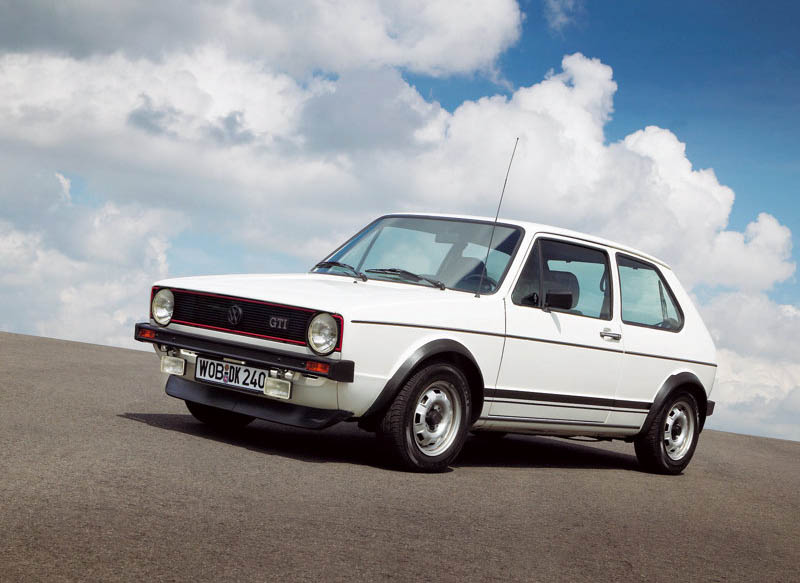
VW Golf I GTI, 1976

 
 VW Golf I GTI, 1976

The first Golf began production in 1974. Marketed in the United States and Canada from 1975 to 1984 as the Volkswagen Rabbit and in Latin America as the Volkswagen Caribe, it featured the water-cooled, front wheel drive design pioneered by the Citroën Traction Avant in 1934 with the addition of a hatchback pioneered by the Renault 4 in 1961. The Golf was Wheels magazine's Car of the Year for 1975. The name is short for Golf-Strom, German for Gulf Stream; it was named for that oceanic current to reflect its international character. It was originally named the Rabbit in North America and the Caribe in Latin America, ironically, because marketers decided that no one in the Western Hemisphere would understand the European name.

While the Golf was not the first design with this layout (earlier examples being the Austin and Morris Mini of 1959, the Austin Maxi in the late 1960s and the Fiat 128 3P of the early 1970s), it was very successful, especially since it married these features with Volkswagen's reputation for solid build-quality and reliable engineering.

The Golf was designed by Italian automobile architect / designer Giorgetto Giugiaro, of the ItalDesign design studio. A version of this original Golf model, known as the Volkswagen CitiGolf, is still produced in South Africa as an entry level car.

In 1978, Volkswagen commenced producing the Rabbit version of the Mk1 Golf in Westmoreland County, Pennsylvania, thus becoming the first European car manufacturer in modern times to produce a vehicle in the United States. Former Chevrolet executive James McLernon was chosen to run the factory, which was built to lower the cost of the Rabbit in North America by producing it locally. Unfortunately, McLernon tried to "Americanize" the Rabbit by softening the suspension and using cheaper materials for the interior. VW purists in America and company executives in Germany were displeased, and for the 1983 model year the Pennsylvania plant went back to using stiffer shocks and suspension with higher-quality interior trim. The plant also began producing the GTI for the North American market. (Rabbits were built in Pennsylvania through 1984.) The first VW Caddy pick-up, based on the Mk1 Golf, was also created at the Pennsylvania plant.

The GTI version, launched in Europe in 1976 and in the US in 1983, virtually created the hot hatch genre overnight, and many other manufacturers since have created special sports models of their regular volume selling small hatchbacks. It was one of the first small cars to adopt fuel injection for its sports version, which raised power output of the 1588 cc engine to 110 PS (81 kW/108 hp). In 2004, Sports Car International announced the GTI Mk I as the 3rd best car of the 1980s. In the United States, the Mk1 Golf GTI was known as the Rabbit GTI.

There was a minor facelift in 1980 for North American versions only, which saw the adoption of larger rear lamp clusters (more in line with Guigiaro's original concepts), larger bumpers, square headlights and a new dashboard with a more modern-looking instrument display.

The convertible version, named the Cabriolet, was sold from 1980 to 1993 (a convertible version of the Golf II was not made, so the Mk1 cabrio with slight modification was produced until the introduction of the Mk III cabrio). It had a reinforced body, transverse roll bar, and a high level of trim. The A1 Volkswagen convertible is of unibody construction built entirely at the factory of Karmann, from stamping to final assembly; Volkswagen supplied the engine, suspension, interior, etc. for Karmann to install. The vinyl tops were insulated and manually operated, with a glass rear window.

As of 2006, Volkswagen of South Africa still manufactures two first generation Golfs, the four-door "Citi" Golf and the "Pickup".
Related Posts Plugin for WordPress, Blogger...
Acura, Alfa-Romeo, Alpina, Artega, Ascari, Aston-Martin, Audi, BMW, Bentley, Brabus, Bugatti, Buick, Cadillac, Caparo, Chevrolet, Chrysler, Citroen, Covini, Dacia, Daewoo, Daihatsu, Daimler, Devon, Dodge, Donkervoort, Farbio, Ferrari, Fiat, Fisker, Ford, GM, GMC, Gumpert, Holden, Honda, Hummer, Hyundai, Infiniti, Italdesign, Jaguar, Jeep, KTM, Kia, Koenigsegg, Lamborghini, Lancia, Land Rover, Leblanc, Lexus, Lincoln, Lobini, Lotus, MG, Mansory, Maserati, Maybach, Mazda, Mazel, McLaren, Mercedes-Benz, Mercury, Mindset, Mini, Mitsubishi, Morgan, Nismo, Nissan, Noble, ORCA, Oldsmobile, Opel, PGO, Pagani, Plymouth, Pontiac, Porsche, Renault, Rolls-Royce, Rover, Saab, Saturn, Scion, Skoda, Smart, Spyker, SsangYong, Startech, Stola, Strosek, Torino, Subaru, Think, Toyota, Tramontana, Valmet, Vauxhall, Venturi, Volvo, Wiesmann, Yes, Zagato, Zenvo.