Showing posts with label Dodge. Show all posts

Tuesday, September 25, 2012

Dodge EV Concept, 2008


  •  Dodge EV Concept, 2008
The Dodge EV development Electric Vehicle is a two-passenger, rear-wheel-drive sports car that marries high performance with zero tailpipe emissions based on the Lotus Europa.

"The Dodge EV sets a new standard for what can be expected in electric-drive vehicles," said Lou Rhodes, Vice President - Advance Vehicle Engineering, and President - ENVI. "The electric-vehicle technology enables a fun-to-drive performance sports car and helps redefine the vision of an environmentally responsible vehicle for the Dodge brand."

The electric-drive system consists of three primary components: a 200 kW (268 horsepower) electric motor, an advanced lithium-ion battery and an integrated power controller.

The 200 kW electric-drive motor generates 650 N•m (480 lb.-ft.) of torque. The instant high torque of the electric-drive motor delivers outstanding performance, accelerating the Dodge EV to 60 mph in less than five seconds, with quarter-mile times of 13 seconds. The Dodge EV has a top speed of more than 120 mph.

Working with the latest advanced lithium-ion battery technology, the Dodge EV has a continuous driving range of 150 to 200 miles - more than triple the average daily commute of most consumers. Recharging the vehicle is a simple one-step process: plugging into a standard 110-volt household outlet for eight hours. The recharge time can be cut in half to four hours by using a typical 220-volt household appliance power outlet.

The Dodge EV offers driving enthusiasts a performance sports car that can be driven to work every day - without consuming gasoline or producing tailpipe emissions.

Friday, July 6, 2012

Dodge Dakota, 2008


  • Dodge Dakota, 2008

Chrysler Group unveiled the new 2008 Dodge Dakota mid-size truck with a new engine that not only offers 25 percent more horsepower and 10 percent more torque, but also better fuel economy and increased refinement. The 2008 Dodge Dakota also features new exterior and interior styling, and many best-in-class capabilities. The new truck arrives in dealerships in August.

New for 2008 are striking exterior and interior enhancements that bear signature Dodge styling cues while creating a new persona for Dakota.

Powertrain selections
Dodge trucks have always earned a reputation as bold, powerful and capable. The powerful and capable parts of the equation in the 2008 Dodge Dakota begin with powertrain choices, which include a new V-8 engine -- the only V-8 option available in the mid-size pickup segment.

The new 4.7-liter V-8 offers better fuel economy, power and torque than the previous 4.7-liter High Output engine, while at the same time delivering improvements in refinement. The new 4.7-liter V-8 incorporates two spark plugs per cylinder (the only Chrysler Group engine to do so, other than the 5.7-liter HEMI®), increased compression ratio, improved cylinder-head port flow and a new combustion system. The result is 290 horsepower, a 25 percent increase; and 320 lb.-ft. of torque, a 10 percent increase. The new engine is also capable of operating on E85 ethanol fuel, making the Dodge Dakota equipped with this engine a Flexible Fuel Vehicle (FFV).

Refinement improvements in the new 4.7-liter V-8 result from significant revisions to the induction system, a lightweight piston/rod assembly and reduced accessory drive noise through lower accessory drive speed. Engine smoothness at idle is enhanced with a new valve-lash adjuster system. The new 4.7-liter V-8 is also equipped with Electronic Throttle Control.

The new 2008 Dodge Dakota comes standard with a 3.7-liter Magnum® V-6 engine producing 210 horsepower and 235 lb.-ft. of torque. The engine also comes with Electronic Throttle Control for positive throttle response, and exhaust gas recirculation to help lower emissions.

A first-for-the-segment remote starter for more convenience is standard on both the 3.7-liter and 4.7-liter engines in the 2008 Dodge Dakota.

The new 2008 Dodge Dakota's powerplants are backed up by a choice of a six-speed manual transmission, standard on all V-6 equipped 2008 Dodge Dakota models except Laramie; a four-speed automatic with overdrive available with Dakota's V-6 engine; and a five-speed automatic available on V-8-equipped models.

For more capability when traction is at a premium, the new 2008 Dodge Dakota may be equipped with a transfer case featuring two-wheel drive or four-wheel drive with locked high and low ranges, or an available transfer case with full-time four-wheel drive as well as selections for locked high and low ranges. The 2007 Dodge Dakota is the only pickup in its segment to offer full-time four-wheel drive.

In addition to powerful and capable, Dodge trucks are also known as bold.
For that part of the equation, the 2008 Dodge Dakota's exterior includes a newly styled hood, grille, front fascia, rear spoiler, fenders and headlamps. The front end has been designed to improve aerodynamics and features better fit and gap management. The hood surface was designed to signify power and further amplify the drop-fendered, signature look for Dodge trucks. With these styling enhancements, the "face" of the 2008 Dodge Dakota is better aligned with the rest of the Dodge truck lineup.

Like the Dodge Nitro, headlamps are rectangular units primarily for a contemporary appearance, but also to maximize the surface area for better forward lighting. Reflectors are deep-set behind each lense to achieve a serious demeanor.

All-new fascias better integrate with the restyled grille and incorporate fog lamps. The 2008 Dodge Dakota's tailgate includes a new spoiler that helps smooth air flow over the rear of the truck to improve fuel economy, and the top surface of the cargo box has a new protective surface.

"The Dodge truck DNA is well-understood in the marketplace. We are creators of trucks with a distinct flair for style and no compromise in function," said Ralph Gilles, Vice President - Jeep®/Truck and Color and Trim Studios, and Specialty Vehicles, Chrysler Group Design. "We restyled the 2008 Dodge Dakota to reflect that DNA in a package that presents the Dakota as both a sporty lifestyle vehicle and a work truck."

For 2008, the Dodge Dakota will again be offered in two body styles - Extended Cab and Crew Cab - and six trim levels: ST, SXT, SLT, TRX4, Sport and Laramie.

Interior loaded with form and function
The new 2008 Dodge Dakota's interior includes a new instrument panel, center console and accent finishes, and several new interior storage choices.

"The interior is designed to provide an ergonomically friendly cockpit with improved comfort, utility and thoughtful storage amenities to complement a variety of lifestyles," said Gilles.

The 2008 Dodge Dakota Extended Cab's available Full Swing™ rear access doors open nearly 170 degrees - unique in the segment -- to an interior with class-leading room and seating for five. With rear seats folded, up to 30 cubic feet of storage space is available. A total of six storage hooks are located on the Extended Cab's rear interior panel.

Separately, the 2008 Dodge Dakota Crew Cab offers best-in-class room - 37.1 cubic feet -- and seating for up to six. With rear seats folded, a new under-seat storage system, a first for Dodge Dakota, is easily accessible. This system includes a unique, collapsible and removable cargo management system that enables gear to be organized and taken anywhere.

Other storage options are provided throughout the interior. For example, an additional storage bin is located above the glove box, providing easy access for everyday items. An all-new center console incorporates cup holders with modular inserts and a pull-out bin specifically designed to hold electronics such as an MP3 player (which can be plugged into any of the 2007 Dodge Dakota's audio systems), cell phone or Personal Digital Assistant. An additional power outlet is also provided.

Seating is available with YES Essentials® Worry Free Fabric, which is stain-resistant, odor-resistant and anti-static. Heated bench seats are available in the 2008 Dodge Dakota for the first time.

Seating options include an available 40/20/40 split-bench front seat with a folding center armrest. The 2008 Dodge Dakota Extended Cab is available with 40/40 rear-folding seats, while Crew Cab models have a standard 60/40 split-folding rear seat.

Electronic choices include AM-FM stereo radios with MP3 capability and available SIRIUS Satellite Radio that delivers more than 125 channels of music, sports, news, talk and weather. Also available as stand-alone options are a 508-watt SoundBox system (available on Extended Cab models) and a DVD navigation system with turn-by-turn directions. A power accessory delay, standard on all 2008 Dodge Dakotas, allows power functions, including radio, to operate after the vehicle is turned off.

Dodge Dakota = versatility
The foundation of the new 2008 Dodge Dakota is a ladder-type frame, with main rails formed to precision tolerances under liquid pressure and fully boxed for strength and rigidity. All 2008 Dodge Dakotas feature independent front suspension with coil-over shock absorbers. The result is identical ride height for two- and four-wheel-drive models, which contributes to smooth ride and handling characteristics.

The 2008 Dodge Dakota continues to offer the largest and longest standard cargo bed in its class: 6-foot-6-inches in the Extended Cab. Built-in utility rails make cargo box tie-downs infinitely adjustable. The 2008 Dodge Dakota's dual-position tailgate may be secured in a mid-position, which provides support for extra-wide or -long cargo laid on top of wheel wells and extending beyond the end of the bed.

The new 2008 Dodge Dakota also continues to wear the crown for highest tow ratings in the mid-size pickup market, with towing ability of up to 7,050 pounds.

As a complete package, the 2008 Dodge Dakota is as safe as it is capable and versatile. Up front, octagonal front frame rail tips collapse rearward in an impact in order to absorb energy and deter force from the cabin. An anti-lock brake system is standard on rear wheels, and available on all four wheels.

Advance multi-stage driver and front passenger air bags are standard, and supplemental side-curtain air bags are available. Rear head restraints on Crew Cab models, which are designed for the driver's rearward visibility, have a foam-padded structure for increased protection.

Tuesday, July 3, 2012

Dodge Challenger Targa Concept, 2008

 
  •  Dodge Challenger Targa Concept, 2008

The Dodge Challenger Targa is a full-blown competition car that raced and completed the infamous Targa Newfoundland race this year. "Samantha" started life as a Mopar Challenger drag race package car. 

Many features were borrowed from the Dodge Viper, but the most noticeable is the snakeskin green paint. To keep the front end down, a Mopar chin spoiler "Splats" developed in a full scale wind tunnel, was added to the front of the car. Mopar gauges keep a close eye on the vital signs. 

The Mopar hood is equipped with a scoop to make room for the 540-horsepower, 490 lb. ft. of torque, 392 HEMI V-8 Mopar crate motor. Mated to a Tremec six-speed manual gearbox, the engine blasts power to the rear wheels. An abundance of fade resistant stopping power comes from Stop-Tech brakes. 

Up front, the six-piston calipers clamp 380-millimetre rotors, while in the rear, four-pot calipers work with 355-mm rotors. Developed by KW, the race suspension and brake upgrades came from a proven hero — the Dodge Viper ACR, which just broke the production car lap record at the world-renown Nurburgring in Germany. With only a few exceptions, the Dodge Challenger Targa was built using parts available through Mopar.


Tuesday, June 19, 2012

Dodge Avenger RT, 2008


  •  Dodge Avenger RT, 2008

The Dodge brand is running on all cylinders, introducing the 2008 Dodge Avenger — an all-new mid-size sedan that combines bold, aggressive Dodge styling with innovative interior features, high-levels of safety and reliability, exhilarating performance and excellent fuel efficiency of 30 miles per gallon (mpg) (32 mpg based on 2007 EPA fuel economy standards).

Avenger also is the Dodge brand's first mid-size car to offer all-wheel-drive capability combined with a sport-tuned suspension, performance steering and Electronic Stability Program (ESP) with Traction Control, all of which combine to give Avenger its on-road performance attitude. And with a starting U.S. Manufacturer's Suggested Retail Price of $18,895 (including a $675 destination charge), the all-new Avenger is priced $1,605 below the comparable outgoing Stratus with $985 more content, including standard side-curtain and front-seat-mounted side air bags, Chill Zone, theft alarm and a tilt/telescoping steering wheel, to name a few.

The mid-size sedan also marks a milestone in the Dodge brand's car renaissance. From Viper to Caliber and every segment in between, Dodge now offers an extremely competitive car.

The 2008 Dodge Avenger  available in U.S. dealerships in the first quarter of 2007 and in global volume markets, in both left-hand and right-hand drive, by mid-2007. 4 models offered in the United States: Dodge Avenger SE, Dodge Avenger SXT and Dodge Avenger R/T, and a first for Dodge in the mid-size segment, Dodge Avenger R/T AWD (late availability).

Bold, Aggressive Dodge Styling
The 2008 Dodge Avenger builds on the bold, aggressive styling, performance and excitement of the Dodge Charger.

From the front, there's no mistaking Dodge's heritage in Avenger's aggressive exterior lines. The brand's signature crosshair grille and large, modern quad headlamps housed in black add to Avenger's menacing glare. The Dodge Avenger's chrome grille with black texture accentuates the vehicle's serious, almost sinister appearance. A stamped formation carries the vertical lines of the crosshair grille over the hood.

Avenger's side profile shares more family traits with the Dodge Charger. Muscular rear shoulders, large wheels and tires and a sleek rear spoiler embody the Dodge brand attributes of bold, powerful and capable. Avenger's long greenhouse is created by black appliqués on the B-pillars, which make this mid-size sedan look like it's pouncing forward, even when it's at a standstill.

From the rear, large, expressive tail lamp modules placed at the corners frame the deck lid, which includes a sleekly integrated, finely tuned body-color spoiler. This spoiler and chrome-tipped dual exhaust outlets communicate the performance capability of the Avenger R/T's 3.5-liter engine.

The all-new 2008 Dodge Avenger rides on a 108.9-inch wheelbase and 61.8-inch track, which adds to its athletic stance, improves ride quality and stability and maximizes crush space in the engine compartment. Overall, Avenger is 1.2 inches wider and 4 inches taller than the vehicle it replaces.

Impressive Interior Makes Bold Statement
Graphic design elements, which set the new 2008 Dodge Avenger's exterior design apart from the competition, also are evident throughout the vehicle's spacious interior.

Carefully matched grains and low gloss levels contribute to Avenger's rich-looking interior surfaces. The instrument panel top pad and center stack feature a Franklin grain with low-gloss finish to match the defroster grille, driver cubby and Dodge logo on passenger side surrounds. From the cluster bezel to climate control knobs, circles are a primary graphic element repeated throughout the Dodge Avenger's interior.

Taking a cue from the Dodge Ram name, the Avenger's center stack features a V-like ram's horn shape that surrounds the gated shifter bezel and serves as a design focal point. Avenger's center stack features dual heating and air conditioning vents. A large opening below the vents provides room for either the standard AM/FM/CD radio or the available cutting-edge MyGIG™ Multimedia Navigation/Audio/Entertainment/Communication system. On vehicles equipped with the UConnect® Hands-free Communication System, phone buttons are packaged in the radio control head for easy access and a clean, streamlined appearance.

Unique to Dodge Avenger in the mid-size segment is Chill Zone, a chilled beverage storage bin that is standard on all Avenger models. Housed in the passenger side upper instrument panel, the bin can hold and chill as many as four 12-oz. beverage cans.

Avenger's interior provides comfortable seating for the driver and as many as four passengers. Drivers sit 2.5 inches higher than they did in Dodge's previous mid-size sedan, giving them a command-of-the-road seating position. The interior cabin also is extremely spacious with 100.9 cu. ft. of room, which is an additional 7 cubic feet of interior passenger volume compared with the vehicle it replaces. There are 2.5 inches more headroom, 1.2 inches more shoulder room and an inch more hip room in the front seat. Luggage volume in the trunk is a competitive 13.35 cubic feet.

All-wheel Drive, Sport Suspension and Performance Steering Accentuate Avenger R/T's On-road Attitude
The Avenger R/T also is the Dodge brand's first mid-size sedan to offer all-wheel-drive capability (late availability). Avenger's all-wheel-drive system, available on models sold in the United States, works on demand, driving only the front wheels until power to the rear wheels is needed. All-wheel drive also is used on dry pavement between speeds of 25 and 65 mph to enhance handling during performance driving. This system provides added traction on snow, ice and other low-traction surfaces without having to be switched on and off. All-wheel drive, combined with a sport-tuned suspension, performance steering and ESP with Traction Control, all combine to give Avenger R/T its on-road performance attitude.

Powertrain Options Deliver Excellent Power, Fuel Efficiency and Flex-fuel Availability
Three engine options power 2008 Dodge Avengers sold in the United States: the new standard 2.4-liter four-cylinder World Engine, an available flex-fuel 2.7-liter V-6 engine and an available 3.5-liter V-6 engine coupled with a new six-speed automatic transaxle with Auto Stick.

The 2008 Dodge Avenger SE and SXT feature a standard four-cylinder engine that rivals the best in the mid-size car segment when it comes to fuel economy. Avenger's 2.4-liter World Engine with dual variable valve timing delivers fuel efficiency in the city of 21 mpg (24 mpg using 2007 EPA standards), an excellent 30 mpg on the highway (32 mpg based on 2007 EPA standards), as well as smooth, quiet operation. Mated to a four-speed automatic transaxle, this new engine provides a 15 percent increase in horsepower (173 horsepower vs. 150 horsepower) and an 8 percent improvement in fuel economy compared with the 2.4-liter engine it replaces.

The Dodge Avenger SXT features  Flexible Fuel Vehicle (FFV) 2.7-liter V-6 engine that provides value- and performance-conscious consumers the power of a V-6 engine with a price that compares with the competitions' four-cylinder engines. Avenger's 2.7-liter V-6 engine produces 189 horsepower and 191 lb.-ft. of torque, providing more low-end torque (at an rpm 850 lower) compared with the 2.7-liter engine it replaces. This 2.7-liter V-6 engine achieves 19 mpg in the city (22 mpg based on 2007 EPA standards) and 27 mpg on the highway (30 mpg based on 2007 EPA standards). It also can operate effectively on any blend of gasoline and fuel-grade ethanol up to E-85.

Dodge Avenger R/T and R/T AWD sedans sold in the United States feature a standard 3.5-liter V-6 engine that produces 235 horsepower and 232 lb.-ft. of torque coupled with a new six-speed automatic transaxle that comes standard with Auto Stick. The combination of the upgraded 3.5-liter V-6 engine and six-speed automatic transaxle delivers excellent performance and fuel efficiency, as well as smooth, quiet operation.

The 2008 Dodge Avenger R/T's six-speed automatic transaxle provides quicker standing-start acceleration than a four- or five-speed transaxle because of its numerically higher first gear ratio. A more robust differential with increased torque capacity enhances launch performance by requiring less torque management, electronically limiting the torque that is available during the initial stages of standing-start acceleration. Smaller steps between ratios also make for a smoother, quieter ride, as the engine speed doesn't change as often with each shift. In addition, more ratio choices, more appropriate ratios for quicker acceleration and a lower overall top gear ratio provide a quiet ride and improved fuel economy at highway speeds.

Innovative Technologies Make Life Easier and Safer

In addition to Dodge Avenger's bold, aggressive design and functional interior, this all-new mid-size sedan also features a slew of new technologies unique in the segment.

Many unique features set Dodge Avenger apart in the extremely competitive mid-size car segment. The features:
  • Chill Zone — a storage compartment in the top of the instrument panel that holds up to four standing 12 oz. beverage cans. Depending on ambient temperature and air conditioning settings, the bin can keep beverages cool
  • A heated/cooled front cupholder that keeps cold beverages cool and hot beverages warm. The system heats to 140 degrees Fahrenheit or cools to 35 degrees Fahrenheit
  • YES Essentials Fabric — an easy-care, soil-repellent and anti-microbial textile that protects seats from stains, odors and discoloration
  • Heated cloth seats
  • An available DVD rear-seat entertainment system that includes AM/FM stereo radio with MP3 capable CD/DVD player, six-disc CD/DVD changer and SIRIUS Satellite Digital Audio Radio
  • Light-emitting Diode (LED) interior lighting with high-focus white lights that provide directional lighting in both the front and rear seats
  • MP3 play capability on all audio systems

The 2008 Dodge Avenger also features MyGIG™, a cutting-edge information, entertainment and safety navigation audio system that raises the bar on in-vehicle communications. This best-in-class, next-generation navigation radio features a 6.5-inch Thin Film Transistor (TFT) Display with a touch-screen panel that can support 65,000 colors, providing a three-dimensional appearance to graphics and animation, as well as multiple font sizes and styles. The MyGIG system follows voice-activated commands and includes many new features for music, sound, movies and personalized picture displays:
  • A 20 gigabyte hard disc drive that includes Music Juke Box for organizing music and pictures on the hard drive
  • Universal Serial Bus (USB) that provides both MP3 connectivity and downloading of WMA, MP3 and JPEG files onto the hard drive
  • Gracenote database installed on the hard drive, which provides song identification, including composer, artist and title
  • Playlist creation capability to provide easy access to files
  • Voice memo recording, which allows a message up to 3 minutes long to be recorded using the microphone integrated into the rearview mirror
  • Radio screen, which can display movies (when vehicle is not in motion)
  • SIRIUS Satellite Radio, which provides customers with more than 125 channels of the best music, entertainment and information coast-to-coast, 24 hours a day. This includes 100 percent commercial-free music, as well as sports, news, talk, entertainment, traffic and weather
  • UConnect Hands-free Communication System that uses Bluetooth® technology to provide voice-activated wireless communication between the occupants' compatible cell phones and the vehicle's onboard receiver. The hands-free option promotes safety, freedom, value and flexibility

Safety Features and Structure Combine to Protect Vehicle Occupants
Safety and security are a top priority among mid-size car buyers in the United States, and the all-new 2008 Dodge Avenger offers a unique combination of class-leading safety features that are designed to keep occupants both safe and secure. Avenger's safety cage is constructed with dual-phase, high-strength and ultra-high-strength steel components designed to protect occupants in all driving situations. Avenger's extremely strong safety cage is complemented with a combination of standard safety items demanded by buyers in the mid-size segment, including:
    * Advanced multi-stage front air bags
    * Side-curtain air bags
    * Front-seat-mounted side air bags

Anti-lock brakes and ESP with Traction Control also are available on the 2008 Dodge Avenger.

Monday, April 23, 2012

Dodge Circuit EV, 2009


Dodge Circuit EV, 2009

The Dodge Circuit EV displays bold exterior and interior styling with outstanding performance, zero gasoline consumption and zero tailpipe emissions.

The Dodge Circuit EV design screams pure sports car from every angle. The Dodge Circuit EV's profile demonstrates perfect proportions for balanced handling, placing the driver and passenger midway along the wheelbase. At the front of the vehicle, the distinctive Dodge crosshair grille splits the wind, sending it over the long, low hood and cleanly over the windshield and cockpit. The body sides feature a deep scallop, providing visual depth and also a functional rear-brake air duct. At the rear, the functional elements blend with design to create a uniform finish.

The Dodge Circuit EV is adorned in all-new "Tangoreen" exterior color, wearing large "EV" graphics on both sides of the sports car.

The uncomplicated interior of the Dodge Circuit EV delivers a combination of pure function and athletic refinement. The cockpit design puts complete control of the car at the driver's fingertips. Nestled within a leather-covered instrument cluster are two primary analog-face gauges. A digital display conveys information regarding the electric-drive system.
The seats feature deep bolsters and are covered in premium leather. The same premium leather covers the center console and the width of the instrument panel.

The Dodge Circuit EV delivers all of the convenience features of a performance sports car, including premium sound system, power windows and door locks, air conditioning, speed control.

Propelled by a completely electric ENVI drivetrain, the Dodge Circuit EV posts impressive performance numbers:
  •     * 0-60 mph in less than 5 seconds
  •     * ¼-mile in 13 seconds
  •     * Top speed of more than 120 mph
The Dodge Circuit EV utilizes just three powertrain components. These include a 200 kW (268 horsepower) electric motor to drive the wheels, an advanced lithium-ion battery system to power the electric-drive motor, and a controller that manages energy flow.

Working with the latest advanced lithium-ion battery technology, the Dodge Circuit EV has a driving range of 150 to 200 miles between charges - more than triple the average daily commute of most consumers. Recharging the vehicle is a simple one-step process: plugging into a standard 110-volt household outlet. The recharge time can be cut in half by using a typical 220-volt household appliance power outlet.

The Dodge Circuit EV offers driving enthusiasts a performance sports car that can be driven to work every day - without consuming gasoline or producing tailpipe emissions.

Dodge Challenger SRT10 Concept, 2008


Dodge Challenger SRT10 Concept, 2008

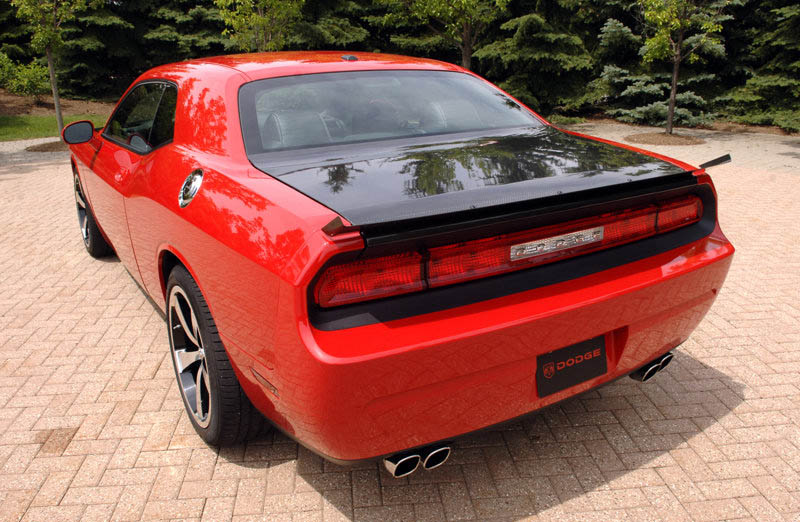
The opportunity for SRT engineering to "one-up" itself comes to fruition with the Dodge Challenger SRT10 Concept. Power for the car comes from the Dodge Viper 8.4-liter, all-aluminum V-10 engine with 600 horsepower and 560 lb. ft. of torque. It's a vehicle that delivers the well-known SRT credo of benchmark performance. 

The Dodge Challenger SRT10 Concept includes a fresh coat of Tornado Red paint with a carbon-fiber deck lid and hood. The "shaker hood" is a nostalgic representation of the 1970 HEMI Cuda, giving the 600-hp Viper V-10 engine room to breathe. Brakes have been upgraded and BILSTEIN shocks at all four corners improve handling balance. The interior boasts sport seats and carbon-fiber accents throughout and, of course, true to the Viper-powered vehicle lineage, a red engine start push-button in the dash.

Wednesday, February 8, 2012

Dodge Challenger TA, 1970

Dodge Challenger TA, 1970

The first Challenger was the division's late entrant to the pony car market segment in the United States, launched for the 1970 model year.
It's strongly based on the similar Plymouth Barracuda's new E-body but with two inches (51 mm) of extra wheelbase and somewhat different outer sheetmetal. Exterior design was done by Carl "CAM'" Cameron, whom also did the exterior for the 1966 Dodge Charger. For the 1970 Challenger grille, CAM' based it off of an older sketch of his of a 1966 Charger prototype that was designed to have a turbine engine. The Charger never got the turbine, but the Challenger got that car's grille. Although the Challenger was well-received by the public (with 80,000 sales in 1970 alone), it was criticized by the press, and the pony car segment was already declining by the time the Challenger arrived. Challenger production ceased after the 1974 model year, only having lasted five years; performance dropped off dramatically after the 1971 models. About 165,500 Challengers were sold over this model's lifespan.

The Challengers could either be hardtop coupes or convertibles (through 1971 only). The performance model was the R/T (Road/Track), available in both body styles; both standard and R/T hardtops could be ordered as the more luxurious SE specification, which included leather seats, a vinyl roof and a smaller 'formal' rear window. The convertible Challnger was only available as an R/T in 1970. In 1972, Dodge dropped the R/T badging and now called it the "Rallye". Other options, as well as engines and a manual transmission, included steeper rear axle ratios, a limited-slip differential, and a shaker hood scoop were gone for 1972.

A 1970-only model was the Dodge Challenger T/A (Trans Am) racing homologation car, which used a specially tuned Six-Pack version of the 340 in³ (5.6 L) engine, topped with a giant hood scoop on a fiberglass hood. 'Megaphone' exhaust outlets were fitted in front of the rear wheels. These cars came standard with front and rear sway bars to enhance handling. Unusually, different-sized wheels were fitted front and back, with very fat rubber on the rear. The T/A also came with a rear ducktail spoiler and front ground effect spoilers as standard equipment.

By 1972, all big-block engines were gone, maximum power was down to 240 hp, and production ceased in mid-1974.
Although the body style remained the same throughout the 5 year run, there were two notable changes to the front grille. 1971 models had a more stylized "split" grille, and the final manipulation coming in 1972, with the incorporation of the "sad-mouth" design. With this change to the front end, 1972 through 1974 models had little to no variation.

The 1970 taillights went all the way across the back of the car, with the backup light in the middle of the rear. In 1971, the backup lights were on the left and right instead of the middle. The taillight array also changed for 1972 onwards, with the Challenger now having four individual lamps similar to the mid-size Mercurys of the time.

The value
As the Chrysler E-body line reaches legendary proportions, so too do the prices to buy them. 1970 and 1971 models tend to generate more attention from potential (and usually deep pocketed) buyers, as the performance and style options had not yet been toned down. However, with the popularity of these vehicles on the increase, coupled with the number of useable and restorable Challengers being on the decrease, many collectors have begun looking towards the later models to create their own customizable dream machines. Indeed, many "clones" of the more visceral 1970 and 1971 Challengers have been created by using 1972 through 1974 donors; The front and rear grilles/bumpers on these vehicles are easily interchangeable. However, the tail panel is not so easy to change, since the 1970 and 1971 tail panels are quite different from the 1972 to 1974 models.

Dodge Charger, 1969

Dodge Charger, 1969

The 1966 to 1974 Chargers were the high performance B-body models. The 1975 to 1978 Chargers were based on the Chrysler Cordoba.

1969
In 1969 not much was changed for the popular Charger. Exterior changes included a new grille with a center divider and new longitudual taillights. A new trim line called the Special Edition (SE) was added. This could be available by itself or packaged with the R/T, thus making an R/T-SE. The SE added leather inserts to the front seats only, chrome rocker mouldings, a wood grain steering wheel and wood grain inserts on the instrument panel. A sunroof was added to the option list as well, and it would prove to be a very rare option. The bumble bee stripes returned as well, but were changed slightly. Instead of four stripes it now featured one huge stripe framed by two smaller stripes. In the middle of the stripe an R/T cutout was placed. If the stripe was deleted, then a metal R/T emblem was placed where the R/T cutout was. Total production dropped slightly to around 85,680 units. But in 1969 Dodge had its eye on NASCAR and in order to compete it would have to create two of the most rare and desirable of all Chargers: Charger 500, and the Charger Daytona.

The television series The Dukes of Hazzard (1979-1985) featured a 1969 Dodge Charger R/T that was named The General Lee, often quoted as the most recognizable car in the world. "The General" sported the Confederate flag painted on the roof and the words "GENERAL LEE" over each door. The windows were always open, as the doors were (allegedly) welded shut. The number "01" is painted on both doors. When the horn button was pressed, it played the first 12 notes from the de facto Confederate States anthem "Dixie's Land". The muscle car performed spectacular jumps in almost every episode, and the show's popularity produced a surge of interest in the car. The show itself purchased hundreds of Chargers for stunts, as they generally destroyed at least one car per episode. (Real Chargers stopped being used for jumps at the end of the show's sixth season, and were grudgingly replaced with miniatures.)

Tuesday, November 23, 2010

Dodge 2 dr. Sedan (hotrod), 1933

Dodge 2 door sedan (hotrod), 1933


1933 Dodge 2 door sedan, hotrod. Engine 350

Friday, April 30, 2010

Dodge Charger

Dodge Charger, 1968


There have been a number of vehicles bearing the Charger nameplate, but the name has generally denoted a performance model in the Dodge range. The 1966 to 1974 Chargers were the high performance B-body models. The 1975 to 1978 Chargers were based on the Chrysler Cordoba.

1968
It was clear after the sales drop of the 1967 Charger that a restyle was in order. Dodge was going to restyle their entire B-body lineup for 1968 and decided that it was time to separate the Coronet and Charger models even further. What designer Richard Sias came up with was a double-diamond design that would later be referred to as "coke-bottle" styling. From the side profile the curves around the front fenders and rear quarter panels look almost like a Coke bottle. On the roof a "flying buttress" was added to give the rear window area a look similar to that of the 1966 Pontiac GTO. The Charger retained its full-length hidden headlight grille, but the fully rotating electric headlights had been replaced by a simple vacuum operated cover, similar to the Camaro RS. The full length taillights were gone as well. Instead, dual Corvette-inspired taillights were added. Dual scallops were added to the doors and hood to help accent the new swoopy lines. Inside, the interior shared almost nothing with its first generation brothers. The four bucket seats were gone, the console remained the same as the '67. The tachometer was now optional instead of standard, the trunk and grille medallions were gone, the carpeting in the trunk area was gone, replaced by a vinyl mat, the rear seats did not fold forward and the space-age looking electroluminescent gauges disappeared in favor of a more conventional looking design.

In order to further boost the Charger's muscle car image, a new high-performance package was added, the R/T. This stood for "Road and Track" and would be the high performance badge that would establish Dodge's performance image. Only the high performance cars were allowed to use the R/T badge. The R/T came standard with the previous year's 440 "Magnum". The Slant Six was added to the option list in 1968, but it proved to be a very poor seller. Most people wanted a V8 in their Charger. The rest of the engine lineup (318-2, 383-2, 383-4, 426-8) remained unchanged.

In 1968 Chrysler Corporation unveiled a new ad campaign featuring a Bee with an engine on its back. These cars were called the "Scat Pack". The Coronet R/T, Super Bee, Dart GTS and Charger R/T received bumble-bee stripes (two thin stripes framing two thick stripes). The stripes were standard on the R/Ts and came in red, white or black. They also could be deleted at no cost. These changes and the new Charger bodystyle proved to be very popular with the public and helped to sell 96,100 Chargers, including over 17,000 Charger R/Ts.

A famous Charger was the four-speed, triple-black 1968 Charger R/T used in the movie Bullitt. The chase scene between Steve McQueen's fastback Mustang GT and the hitmen's Charger R/T is popularly regarded as one of the greatest car chase scenes ever filmed.

Sunday, April 11, 2010

Dodge Charger

Dodge Charger, 1966


There have been a number of vehicles bearing the Charger nameplate, but the name has generally denoted a performance model in the Dodge range. The 1966 to 1974 Chargers were the high performance B-body models.

1966
Carl "CAM'" Cameron would be the exterior designer of Dodge's new flagship vehicle, and on January 1, 1966, viewers of the Rose Bowl were first introduced to the new "Leader of the Dodge Rebellion", the 1966 Charger. The Charger's introduction coincided with the introduction of the new street version of the 426 Hemi. Finally, Dodge would have the performance image to go along with this performance engine.

As the 1966 Charger's features would go, the "electric shaver" grille used fully rotating headlights that when opened or closed made the grille look like one-piece. Inside, the Charger used four individual bucket seats with a full length console from front to rear. The rear seats and console pad also folded forward, and the trunk divider dropped back, which allowed for lots of cargo room inside. Many other things were exclusive to the Charger such as the door panels, courtesy lights and the instrument panel.

The instrument panel was especially interesting as regular bulbs weren't used to light the gauges. Instead four electroluminescent dash pods housed the tachometer, speedometer, alternator, fuel and tempature gauges. In the rear the full length taillight read CHARGER.

The engine selection was all V8s. A six cylinder engine didn't make the option list until 1968. In 1966 four engines were offered; the base-model 318 in³ 2-barrel V8, the truck-sourced 361 in³ 2-barrel, the 383 4-barrel, and the new 426 Street Hemi. The majority of 1966 Chargers were ordered with the 325-hp 383.

Total production in 1966 came to 37,344 units, which was successful for the mid-year introduction.

In 1966 Dodge took the Charger into NASCAR in hopes that the fastback would make their car a winner on the high-banks. But the car proved to have rear end lift around corners which made it very slippery on the faster tracks. The lift was because the air actually travelled faster over the top of the car than under it, causing the car to act like a giant airplane wing. Drivers would later claim that "it was like driving on ice." In order to solve this problem Dodge installed in a small lip spoiler on the trunk lid which improved traction at speeds above 150 mph. They also had to make it a dealer-installed option in late 1966 and through 1967 because of NASCAR rules (with small quarter panel extensions in 1967). The 1966 Charger was the first US production vehicle to have a spoiler. David Pearson, driving a #6 Cotten Owens-prepared Charger, went on to win the NASCAR Grand National championship in 1966 with 14 first-place finishes.

Dodge Coronet Police Vehicle

Dodge Coronet Police Vehicle, 1959


Dodge Coronet Police Vehicle, 1959

The Coronet was a full-size car from Dodge from the 1950s. Positioned above the Coronet, but sharing the same chassis, were the Dodge Royal and Dodge Custom Royal. By the 1960s, the name was transferred to Dodge's mid-size entry. In the early fifties, the Meadowbrook was the four door version of the Coronet.

Friday, March 19, 2010

Dodge Ram Rover Wagon

Dodge Ram Rover Wagon 1951


Dodge Ram Rover Wagon 1951

Dodge Airflow Tanker Truck

Dodge Airflow Tanker Truck 1938


Dodge Airflow Tanker Truck 1938
Related Posts Plugin for WordPress, Blogger...
Acura, Alfa-Romeo, Alpina, Artega, Ascari, Aston-Martin, Audi, BMW, Bentley, Brabus, Bugatti, Buick, Cadillac, Caparo, Chevrolet, Chrysler, Citroen, Covini, Dacia, Daewoo, Daihatsu, Daimler, Devon, Dodge, Donkervoort, Farbio, Ferrari, Fiat, Fisker, Ford, GM, GMC, Gumpert, Holden, Honda, Hummer, Hyundai, Infiniti, Italdesign, Jaguar, Jeep, KTM, Kia, Koenigsegg, Lamborghini, Lancia, Land Rover, Leblanc, Lexus, Lincoln, Lobini, Lotus, MG, Mansory, Maserati, Maybach, Mazda, Mazel, McLaren, Mercedes-Benz, Mercury, Mindset, Mini, Mitsubishi, Morgan, Nismo, Nissan, Noble, ORCA, Oldsmobile, Opel, PGO, Pagani, Plymouth, Pontiac, Porsche, Renault, Rolls-Royce, Rover, Saab, Saturn, Scion, Skoda, Smart, Spyker, SsangYong, Startech, Stola, Strosek, Torino, Subaru, Think, Toyota, Tramontana, Valmet, Vauxhall, Venturi, Volvo, Wiesmann, Yes, Zagato, Zenvo.