Showing posts with label Italdesign. Show all posts

Saturday, August 11, 2012

Italdesign Tex Concept, 2011


  •  Italdesign Tex Concept, 2011

4 real seats, front wheel drive and a gently aggressive line, the Tex fits into a long tradition of Volkswagen brand sports cars.

Compact, very low (1355 mm in height) and 1750 mm wide, the Tex at first glance looks like a sports car with great grip on the road, stressed by the large 19" wheels at the ends and generous wheel arches.

Its set-up is that of a classic two-door coupé whose clearly sporty personality is emphasised by an aggressive front and its rear flaunting two spoilers.

The side view is marked by lines that sculpt the doors next to the air exit of the front wheels and its waistline that rises up toward the tail.

The front is distinguished by a slender grille that encloses the light clusters in an unprecedented trapezoidal shape and three air intakes in the bumper/spoiler zone, necessary for cooling the brake discs and 1.4-litre turbo engine. The VW badge sits in the centre of the grille and is optically underscored by the V-shaped groove of the bonnet. Windscreen and roof are a single piece of glass that becomes dark electronically.

The large rear window dominates the rear and accommodates two spoilers, with the windscreen wiper housed in one at the bottom. Like the Go! previously, the light clusters are under the windscreen and are invisible when the panel is off. Access to the luggage compartment is permitted by raising just the rear window and, once it is open, the light indicators are repeated by the two supplementary tail lights located in the lower part of the bumper, at the sides of the rear air intake that also contains the rear fog lights.

INTERIOR
As in the Go!, the Tex's interiors have also been designed to offer the occupants maximum space and maximum ergonomics. The passenger compartment is definitely geared to the driver. All of the instruments are positioned in a functional manner and wrap around the driver so as to leave the passenger an incredible sensation of space. The large dashboard containing the controls and driving information grows smaller as it approaches the door panels so as to make getting in and out of the passenger compartment easier.

"We designed the interiors so that the first sensation would be that of entering a sports car," continued Fabrizio Giugiaro. "The driver has to be able to find himself, and this is why we chose finish details and elements that refer back to the classic idea of the sports car. We have adopted the large gear knob and leather interiors, with the speedometer and rev counter situated in the classic position behind the steering wheel and with 'analogue' graphics, precisely for that reason".

If the outfitting is classic in style, the contents are instead full of the maximum technology available today. All of the controls and indicators are housed in LCD screens, as is the infotainment console put on a touchscreen in the centre of the dashboard, set in a transparent structure that lays bare the structure.

The dashboard is separated from the central tunnel, an unusual solution for a car, but wraps around the driver with a graphic and colour continuity.
The two rear seats are independent and can be folded down.

STRONG HEART, GENTLE SOUL
The Tex is fitted out with the hybrid plug-in system called Twïn Drive conceived and developed by Volkswagen.

The Twïn Drive couples a 1.4-litre turbo internal combustion engine with a battery-powered 85 kW peak electrical system capable of developing 400 Nm when used combined together.
It has front-wheel drive with a 7-gear Direct Shift gearbox with gearshifting on the steering wheel.

Its performance is that of a pure sports car. The Tex is able to reach 100 km/h from a standstill in about 6 seconds, and reach a top speed of 220 km/h.

However, in this case sportiness and eco-friendliness are not worlds apart. The Tex is able to cover approximately 35 km in the totally electric mode, mostly enough for getting around during the day.

Tuesday, July 10, 2012

Italdesign Go Concept, 2011


  • Italdesign Go Concept, 2011

Designed for the city, the Go! together with the sporty Tex could increase the wide range of Volkswagen products to A0 segment even more.

With the same wheelbase as that of the Passat - 2700 mm - the Go! is a hatchback boasting a total length of 3990 mm thanks to its smaller overhangs. The battery pack is housed underneath the front and rear seating positions. This vertical package allows for the Go! a weight distribution of 58% on the front and 42% on the rear.

The design of the exteriors is dominated by extensive glass surfaces, in clear contrast with the trends of recent years of providing cars with increasingly smaller windows. In addition to filling the passenger compartment with light and giving its occupants the chance to thoroughly enjoy city scenery, also thanks to its totally glass roof, this design offers the driver with maximum visibility while driving.

The A pillar is in particular considerably farther forward than its traditional position, and the bulk of the door mirrors is eliminated by using cameras. The side windows also extend beneath the waistline - markedly high and optically taken up again by adding a longitudinal structure that crosses the side windows - drawing on a solution introduced in 1988 with the Asgard prototype.

This lets the driver benefit from maximum visibility even during manoeuvres and when taking tight curves.

Like in the Emas, only the lower part of the windows (the part beneath the longitudinal structure) can be electrically lowered. This solution reduces the weight that the electric window mechanism has to support to a minimum, and is in any case necessary for meeting all of the essential operations such as paying tolls or refuelling.

The seat H point (corresponding to the passenger hip position) is located higher than that of mass-produced cars but lower than that of an SUV. This solution makes getting in and out of the passenger compartment extremely comfortable.

An electronically driven system pushes the door outwards and pulls it back parallel to the vehicle body for gaining access to the rear seats. This mechanism, which draws on the one used on the VW Milano Taxi (presented in May 2010), offers the advantageous practicality of sliding doors but without sacrificing their section (room is found inside for a comfortable armrest) and makes it possible to do away with the unattractive tracks on the body typical of this solution.

Without sacrificing the family feeling typical of the Golf and the Golf Plus, the Go! offers innovative solutions both in the front and back that combine aesthetic pleasure with practical functionality.

The grille, dominated by the large VW badge in the centre, incorporates the front light clusters with Xenon/LED technology. The air intake is placed at the height of the fog lights and horizontally splits the front spoiler, adjusting the air flow necessary for cooling the front electric motors.

The tailgate reintroduces the theme of the glass surfaces interrupted by a longitudinal insert that not only optically takes up the theme characterising the side view, but conceals the windscreen wiper and rear cameras that turn on when the reverse gear is engaged.

To make loading luggage easier, the tailgate can be operated electronically for both opening and closing. A sensor that activates the opening mechanism by simply moving the foot is also fitted underneath the bumper.

The light clusters are positioned under the glass surface and are invisible when the panel is off. When the tailgate is opened, they are repeated by two additional taillights located in the lower part of the bumper, beside the rear air intake, which also house the rear fog lights.

INTERIOR
Ergonomics is certainly the word that best describes the concept of the Go!'s interiors.
All of the elements have been styled and designed while keeping man in mind. Every single detail - from entering the car and using its controls to the shape of the seats and the instruments - has been designed from an ergonomic point of view.

The driver and three passengers sit on four identical and electronically adjustable seats. Those in the rear can also be folded down using an electronic adjustment mechanism and with remote control, and they form a single surface on the rear floor panel level to increase the maximum loading volume to 525 litres.

A storage console/sliding armrest sits between the front seats. If completely pulled back, it aids the driver when getting out from the passenger side. This solution is particularly useful if parking is narrow or if there are objects blocking the opening of the left door.

The monitors of the rear view cameras are also at the base of the windscreen, but at the two side ends.
The dashboard contains a touchscreen monitor in the classic position. It groups together all of the auxiliary controls, the infotainment system, the satellite navigation system and, when the reverse gear is engaged, the images of the camera for manoeuvring.

ECO-FRIENDLY ESSENCE
The Go! is equipped with the electrical Blue-e-motion system totally designed and developed by Volkswagen.

Ideal for city traffic, the blue-e-motion system lets the Go! travel roughly 240 km in the combined cycle without emitting even a single gram of CO2.

Wednesday, May 16, 2012

Italdesign Emas Country Concept, 2010


  • Italdesign Emas Country Concept, 2010

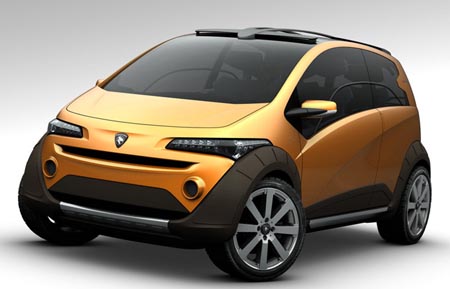
The Emas Country interpretation portrays the Emas as an urban SUV, keeping to the length of 3550 mm but switching to a three-door architecture.
Access to the car is still easy due to generous doors measuring no less than 1350 mm in length and the ergonomic and rational position of the rear seats, that are set 120 mm further forward than in the five-door version.

In particular, the amount of passenger room rises from 4 to 5 seats by replacing the two independent rear seats with a sliding three-seater bench seat. This means that the amount of foot room for passengers in the rear can be adjusted according to requirements.

The bench seat can also be folded completely flat to increase the load volume: this boosts the luggage space from 390 to approximately 780 litres.
A few telling touches create a distinctive off-road exterior look: wheel arches, side-sill perimeter base, bumpers toughened by radial ribbing and the lower part of the tailgate are highlighted by a bronze metallic finish. The roof features a rollbar/roof-rack.

The front-end differs from the urban, five-door version due to its more aggressive look: the Proton shield is now fitted at the top of a grille surmounting a large longitudinal air intake. The two fog lights are round and sunk into the body.
The lower part of the front and rear bumpers and the side-sills are toughened by metal inserts.

A glance at the interiors
The first aspect that strikes you, even before you discover the car interiors, is the door handle: an ergonomic design that incorporates a set of secondary controls that vary from place to place.
The driver can use the handle grip to control all four power windows, door locking and unlocking, the courtesy lights, side mirror adjustment and electrical lowering of the rear head restraint to improve visibility while reversing.

The front passenger can also adjust the hi-fi system as well as his or her own window. The rear passengers can also adjust their seats from the handle grip.
Two TFT panels dominate the dashboard. They are housed side by side in the centre of the dashboard, at a concave angle.

The right-hand monitor shows the speedometer and the main car operating indicators in addition to hybrid system energy flows.
The left-hand monitor shows secondary information such as screens for the hi-fi system, telephone and internet access browser plus personalised car set-up parameters.

A third display, located beneath the central console, is a touch screen that controls all the car's main and secondary functions. The right part of this TFT screen permanently displays the climate system temperature and air flows.
The lower part of the central console, housing the ignition button and gear selector, extends towards the tunnel and can be folded down. When parking in a tight spot, forcing the driver or front passenger to leave the car from the opposite side, this central element can be lowered and the seat moved back so that they can get out on the other side without hindrance.

The central console also houses two USB ports to connect digital music players and mobile phones, plus an SD card slot for satellite navigation maps.
The central part houses a dock specially designed for the Apple iPhone. This dock is interchangeable and can house other phone and smartphone models. It can recharge the phones and connect them automatically to the car without the need to use other coupling systems.

Powered by Lotus Engineering

The drive system is a series hybrid plug-in developed by Lotus Engineering, a Proton Group company. It includes a 3 cylinder 1.2 litre internal combustion engine developing 51 horsepower (38 kW) at 3500 rpm that can run on petrol, ethanol, or methanol.
The front transverse internal combustion engine is coupled to a generator and serves exclusively to recharge the 11.5 kWh capacity lithium ion batteries.

Drive is assured by an electric motor with continuous power of 45 kW and 75 kW peak power.
The high maximum torque, 240 Nm, does not require the use of a gearbox.
Acceleration 0-100 km/h takes place in 14 seconds, top speed is 170 km/h and battery range in the hybrid configuration is 50 km. Full recharging of the battery pack takes three hours using a traditional 240-volt outlet.

The performance and range of the City three door electric plug-in version are currently being assessed.

Tuesday, May 8, 2012

Italdesign Emas Concept, 2010


Italdesign Emas Concept, 2010

The forerunner of the Emas family is a five door hatchback with the emphasis on Comfort, because the rear seats are the same as the front seats to create four business class seats within just 3550 mm of total length.

The front-end features the Proton Shield housed in a longitudinal slot below the bonnet. This also incorporates the light clusters and is enhanced by two distinctive diamond-shaped fog lights. The engine cooling air intake, located between the fog lights, is concealed within a dark grey trapezoid motif. Its size varies according to the type of engine installed, without altering the look of the front-end.

The side is dominated by a belt line that drops down decisively toward the windscreen pillar to increase side visibility during parking manoeuvres. The side is enlivened by a sculpted shape, enhanced by a rib that runs from the front wheel arch then swoops up toward the rear.

The large wheel arches are perhaps the most distinctive and substantial aspect of the car body; the wheelbase is generous: 2590 mm for a total length of 3550 mm. The wheels are therefore located at the end of the Emas: this gives the impression of a car much bigger than it actually is.

The B pillar is painted black to create the sensation of visual continuity with the side windows, while the C pillar features a motif based on an "E", the initial letter of Emas.

Oceans of glass allow plenty of light into the interior. Only the lower part of the side windows - the part you actually need to open to pay tolls or car parks - is mobile in order to keep the window opening system simpler and lighter.

The windscreen extends along three quarters of the roof to create a sky-dome effect that dominates the view from above. Protective sun blinds are housed in the central crossmember and extend longitudinally toward both the front and rear seats.

The rear view is dominated by a generous rear window incorporating all the tail-lights, which are entirely based on LED technology. These are located beneath the glass and are invisible when the car is turned off. A subtle lip joins both light clusters and surrounds the reversing lights and direction indicators. When the tailgate is open, the lights are replicated by two supplementary tail-lights located in the lower part of the bumpers on either side of the rear air intake.

A glance at the interiors

The first aspect that strikes you, even before you discover the car interiors, is the door handle: an ergonomic design that incorporates a set of secondary controls that vary from place to place.
The driver can use the handle grip to control all four power windows, door locking and unlocking, the courtesy lights, side mirror adjustment and electrical lowering of the rear head restraint to improve visibility while reversing.

The front passenger can also adjust the hi-fi system as well as his or her own window. The rear passengers can also adjust their seats from the handle grip.
Two TFT panels dominate the dashboard. They are housed side by side in the centre of the dashboard, at a concave angle.
The right-hand monitor shows the speedometer and the main car operating indicators in addition to hybrid system energy flows.

The left-hand monitor shows secondary information such as screens for the hi-fi system, telephone and internet access browser plus personalised car set-up parameters.
A third display, located beneath the central console, is a touch screen that controls all the car's main and secondary functions. The right part of this TFT screen permanently displays the climate system temperature and air flows.

The lower part of the central console, housing the ignition button and gear selector, extends towards the tunnel and can be folded down. When parking in a tight spot, forcing the driver or front passenger to leave the car from the opposite side, this central element can be lowered and the seat moved back so that they can get out on the other side without hindrance.

The central console also houses two USB ports to connect digital music players and mobile phones, plus an SD card slot for satellite navigation maps.
The central part houses a dock specially designed for the Apple iPhone. This dock is interchangeable and can house other phone and smartphone models. It can recharge the phones and connect them automatically to the car without the need to use other coupling systems.

Powered by Lotus Engineering

The drive system is a series hybrid plug-in developed by Lotus Engineering, a Proton Group company. It includes a 3 cylinder 1.2 litre internal combustion engine developing 51 horsepower (38 kW) at 3500 rpm that can run on petrol, ethanol, or methanol.
The front transverse internal combustion engine is coupled to a generator and serves exclusively to recharge the 11.5 kWh capacity lithium ion batteries.
Drive is assured by an electric motor with continuous power of 45 kW and 75 kW peak power.

The high maximum torque, 240 Nm, does not require the use of a gearbox.
Acceleration 0-100 km/h takes place in 14 seconds, top speed is 170 km/h and battery range in the hybrid configuration is 50 km. Full recharging of the battery pack takes three hours using a traditional 240-volt outlet.

The performance and range of the City three door electric plug-in version are currently being assessed.

Saturday, April 14, 2012

Italdesign Emas3 Concept, 2010


Italdesign Emas3 Concept, 2010

The Emas3 is the City interpretation: the five-door configuration has been left unchanged while the architecture has undergone drastic changes to reduce the wheelbase by 550 mm to contain the total length within just 3 metres.
The doors used are the same as on the Country version, 1350 mm and allowing easy access, even to rear seat passengers.

The front-end emphasises the different outfit: unlike its big sister, the fog lights are trapezoid in shape and joined by a large rectangular air intake.
The tailgate, produced specifically for this version, is more upright in order to ensure plenty of passenger headroom and acceptable load capacity despite the compact exterior.
The passenger room drops to 3+1 Plus seats. The passenger seated behind the driver has less leg-room but there is still enough space even for an adult.

Depending on the number of batteries chosen to increase the range of this version, devised with solely plug-in electric traction, the passenger room could drop to three or two seats if necessary, with a large luggage compartment.

A glance at the interiors
The first aspect that strikes you, even before you discover the car interiors, is the door handle: an ergonomic design that incorporates a set of secondary controls that vary from place to place.

The driver can use the handle grip to control all four power windows, door locking and unlocking, the courtesy lights, side mirror adjustment and electrical lowering of the rear head restraint to improve visibility while reversing.

The front passenger can also adjust the hi-fi system as well as his or her own window. The rear passengers can also adjust their seats from the handle grip.
Two TFT panels dominate the dashboard. They are housed side by side in the centre of the dashboard, at a concave angle.
The right-hand monitor shows the speedometer and the main car operating indicators in addition to hybrid system energy flows.

The left-hand monitor shows secondary information such as screens for the hi-fi system, telephone and internet access browser plus personalised car set-up parameters.
A third display, located beneath the central console, is a touch screen that controls all the car's main and secondary functions. The right part of this TFT screen permanently displays the climate system temperature and air flows.

The lower part of the central console, housing the ignition button and gear selector, extends towards the tunnel and can be folded down. When parking in a tight spot, forcing the driver or front passenger to leave the car from the opposite side, this central element can be lowered and the seat moved back so that they can get out on the other side without hindrance.

The central console also houses two USB ports to connect digital music players and mobile phones, plus an SD card slot for satellite navigation maps.
The central part houses a dock specially designed for the Apple iPhone. This dock is interchangeable and can house other phone and smartphone models. It can recharge the phones and connect them automatically to the car without the need to use other coupling systems.

Powered by Lotus Engineering
The drive system is a series hybrid plug-in developed by Lotus Engineering, a Proton Group company. It includes a 3 cylinder 1.2 litre internal combustion engine developing 51 horsepower (38 kW) at 3500 rpm that can run on petrol, ethanol, or methanol.

The front transverse internal combustion engine is coupled to a generator and serves exclusively to recharge the 11.5 kWh capacity lithium ion batteries.
Drive is assured by an electric motor with continuous power of 45 kW and 75 kW peak power.
The high maximum torque, 240 Nm, does not require the use of a gearbox.
Acceleration 0-100 km/h takes place in 14 seconds, top speed is 170 km/h and battery range in the hybrid configuration is 50 km. Full recharging of the battery pack takes three hours using a traditional 240-volt outlet.

The performance and range of the City three door electric plug-in version are currently being assessed.
Related Posts Plugin for WordPress, Blogger...
Acura, Alfa-Romeo, Alpina, Artega, Ascari, Aston-Martin, Audi, BMW, Bentley, Brabus, Bugatti, Buick, Cadillac, Caparo, Chevrolet, Chrysler, Citroen, Covini, Dacia, Daewoo, Daihatsu, Daimler, Devon, Dodge, Donkervoort, Farbio, Ferrari, Fiat, Fisker, Ford, GM, GMC, Gumpert, Holden, Honda, Hummer, Hyundai, Infiniti, Italdesign, Jaguar, Jeep, KTM, Kia, Koenigsegg, Lamborghini, Lancia, Land Rover, Leblanc, Lexus, Lincoln, Lobini, Lotus, MG, Mansory, Maserati, Maybach, Mazda, Mazel, McLaren, Mercedes-Benz, Mercury, Mindset, Mini, Mitsubishi, Morgan, Nismo, Nissan, Noble, ORCA, Oldsmobile, Opel, PGO, Pagani, Plymouth, Pontiac, Porsche, Renault, Rolls-Royce, Rover, Saab, Saturn, Scion, Skoda, Smart, Spyker, SsangYong, Startech, Stola, Strosek, Torino, Subaru, Think, Toyota, Tramontana, Valmet, Vauxhall, Venturi, Volvo, Wiesmann, Yes, Zagato, Zenvo.