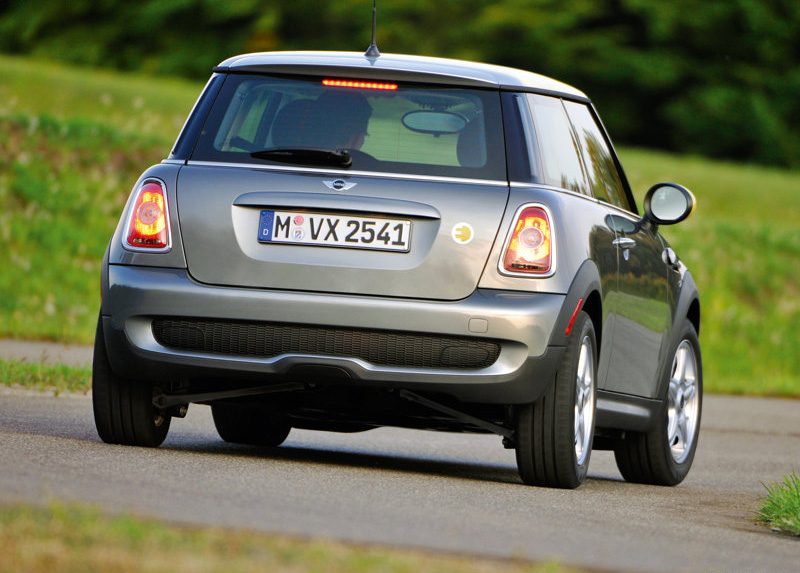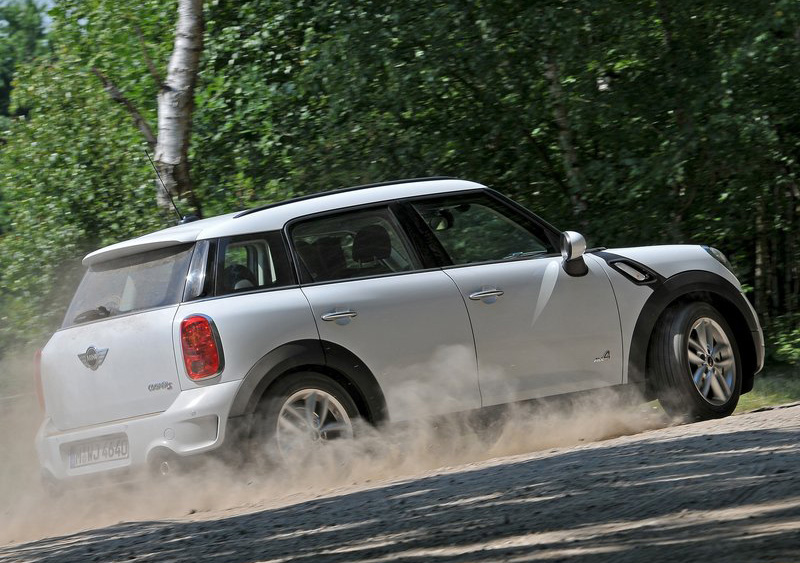


- Mini Countryman, 2011
The MINI Countryman crossover represents a whole new combination of the absorbing handling characteristics of a MINI with the versatile interior of a four-door car and the optimised traction of a Sports Activity Vehicle (in the shape of the optional all-wheel-drive system). At the same time, it provides a fresh and distinctive interpretation of established MINI features as far as design, premium quality, efficiency and customisation are concerned. The brand's fourth model - joining the classic two-door, MINI Clubman and MINI Convertible in the range - meets the challenges of urban mobility with impressive flexibility, captures the imagination beyond traditional MINI territory with its broader range of abilities, and paves the way for an expanding band of prospective customers with varying mobility-based requirements to experience the trademark driving fun of a MINI.
With the long-distance comfort of four individual seats or space for up to five people on board, plus a raised seating position, versatile interior, new generation of powerful and efficient engines and optional MINI ALL4 all-wheel-drive system, the MINI Countryman adds another sprinkling of attractive features to the emotional driving experience of a MINI. Its body and interior concept invite you to share the MINI feeling with friends and in a variety of different situations. This propels the MINI Countryman onto the radar of broader target groups, whose family or leisure pursuits have created an increased need for space and flexibility and who are therefore keen to blend the distinctive style of the brand with innovative functionality and a higher level of interior versatility.
Classic principle, innovative concept, hallmark MINI style.
The unmistakable MINI design language showcases the innovative vehicle concept of the MINI Countryman in fitting style. The first MINI to measure more than four metres (157") in length also follows the principle established for the classic Mini of creating maximum interior space and functionality on a compact footprint. In addition to the classic MINI proportions, characteristic design features at the front, side and rear of the car help to ensure that the MINI Countryman is immediately recognisable as a member of the brand family.
The choice of name for the fourth model in the brand's range also reflects the historic roots and British origins of the MINI. Like the MINI Clubman, the MINI Countryman also builds on the heritage of a forefather based on the brilliant small car concept devised by Alec Issigonis. Indeed, a particularly versatile variant of the classic Mini bearing the Countryman name came onto the market as early as 1960. The Austin Seven Countryman and its technically identical Morris Mini Traveller sister model provided an extra dose of variability, their larger interior offering flexible usage potential. Available for purchase up to 1969, this variant of the Mini - not least the "woody" version with its wooden frame trim on the body flanks and rear doors - achieved a cult status unrivalled to this day.
The MINI Countryman built at the BMW Group's Austrian partner firm Magna Steyr Fahrzeugtechnik in Graz. Production will take place on a separate assembly line set up and operated according to the exacting standards of the BMW Group. As with all the brand's models, the petrol engines for the MINI Countryman will be sourced from the Hams Hall engine plant, one corner of the MINI Production Triangle in England. The newly developed diesel power units, meanwhile, will be produced at the BMW Group's largest engine plant in the Austrian town of Steyr.
MINI Countryman: The first premium model of its kind brings fresh variety to the MINI model family.
As the brand's fourth model and the first premium car of its kind, the MINI Countryman is a pioneer in many respects. The new model is defined by classic MINI features, including its evocative design embodying the unmistakable style of the brand, the agile handling - a.k.a. "go-kart" feeling - which makes a MINI such fun to drive, and its premium quality, in keeping with the high standards of the BMW Group. The MINI Countryman paves the way for new target groups to experience these traits and talents.
The characteristics mentioned above also open up new perspectives for the MINI brand itself. Expanding its model family allows the premium small car manufacturer to bring an unmatched variety to this segment of the market.
In so doing, the MINI brand has demonstrated its ability once again - and more forcefully than ever - to grow with the demands of its fan base and yet remain true to its own identity. The MINI Countryman adds new and intriguing facets to the brand, and presents them in an innovative new body concept.
The design.
The concept of the MINI Countryman puts clear water between the new model and the brand's existing line-up. This new direction is expressed in its confident body design. Measuring 4,097 millimetres (161.3") in length (MINI Cooper S Countryman: 4,110 mm/161.8"), 1,789 (70.4") in width and 1,561 millimetres (61.5") in height, the four-door body combines the customary brand proportions with increased ground clearance and a raised seating position. The MINI Countryman therefore bridges the gap between the classic MINI concept and a state-of-the-art Sports Activity Vehicle.
Like the wider spectrum of possibilities opened up by the innovative body concept of the MINI Countryman, its design embodies the further development of the MINI brand's distinctive design language. The new model showcases fresh interpretations of fundamental MINI design elements.
These include the striking three-level split of body, greenhouse and roof, the front end look (sculpted by large headlights, the hexagonal radiator grille and upright windscreen), the vertically stacked rear lights and the "cascading" contours of the rear, which broaden as they head from roof to wheel. Characteristic MINI design details like the headlights and rear lights integrated like "islands" into the body, the side scuttle between the front wing and door, and the greenhouse tapering back towards the rear of the car also clearly betray the identity of the Countryman as a MINI family member. At the same time their game-altering design gives them a special appeal.
These ingredients combine to highlight both the distinctive character of the new model and its family roots to unmistakable effect. The design of the MINI Countryman exudes originality, performance, a dependable robustness and versatility. And yet the customary MINI charm and individual allure remain resoundingly intact.
Front end with characteristic look and mature presence.
The clear structure of its front end gives the MINI Countryman a mature and stylishly imposing appearance. The upright radiator grille, strikingly contoured bonnet and large headlight units are all characteristic features of the front end. Rising up high, it meets the stipulations of current pedestrian protection legislation and lends the crossover model a powerful stance. The powerdome tapering forward to the front of the bonnet betrays the performance of the engine lurking below.
Together with the main headlights, which occupy the traditional MINI position on the outer edges of the bonnet, the powerdome gives the surface of the car an unmistakable look. The newly designed headlights have chrome surrounds and extend conspicuously far into the shoulders of the car, lending extra emphasis to its width. The shape of the headlights is a marked departure from the classic circular form of the other MINI models in the range. The upper edge slants to the outside, adding further presence to the wheel arches. On the inner edge, meanwhile, they appear to be shrinking away from the broad-spread radiator grille.
The modified form of the radiator grille complements the stand-alone styling of the MINI Countryman: the enclosed hexagonal unit stands more upright than the grilles on the brand's existing models. The three horizontal grille slats of the MINI Cooper Countryman, MINI One Countryman, MINI Cooper D Countryman and MINI One D Countryman reach a long way back, creating a free-floating impression. The slats on the MINI One Countryman and MINI One D Countryman grilles are in high-gloss black, while those on the other model versions are painted matt silver. The front end of the MINI Cooper S Countryman has its very own hexagonal grille design in black and can also be identified by an additional air intake integrated into the grille and ventilation inlets for the brakes.
Larger stature and raised ground clearance define the side view.
From the side the impeccable harmony of the metal body and greenhouse is particularly clear. The familiar MINI three-level split of body, greenhouse and roof is also striking on the Countryman. Despite its height and greater ground clearance, the keynote MINI proportions remain intact. The short front and rear overhangs highlight the brand's trusted philosophy of creating maximum interior space within a compact footprint.
The distinctive contours of the MINI Countryman's roof underline the four-door layout of the body and make the car easily recognisable. Functional roof rails are integrated into the roof as standard, lending extra visual effect to a silhouette reminiscent of a helmet. The greenhouse wraps itself like a glass ribbon around the car and exudes an inviting allure with its powerful transparency. The rising shoulder line of the body lends the greenhouse a "V" shape, which in turn gives the car the appearance of surging forward dynamically - even when at a standstill.
A precise character line, which arcs between the wheels along the lower third of the car's flank, lowers its visual centre of gravity and stretches out the side view. This stylistic bridge between the front and rear axle also serves as a reference to the optional all-wheel drive. The imposing wheel arches grow powerfully out of the body of the car and symbolise its solid roadholding.
The black border around the lower part of the body is more clearly defined on the MINI Countryman than on the brand's other models and underlines the raised ground clearance and clear emphasis on the wheels. The extra-long suspension travel of the wheels is also noticeable and hints at the car's broader range of possible uses. The fresh design of the side scuttle at the transition from front wing to door also helps to set the MINI Countryman apart within the brand family. This element - another new interpretation of the welding seams in a similar position on the classic Mini - houses both the side direction indicators and an air outlet on the MINI Countryman.
The side scuttle has a broad, extremely sturdy-looking design and leads the eye from the A-pillar down towards the front wheel. Like the path of the C-pillar heading towards the rear axle, this line also heightens the impression of the body's powerful over-the-wheels stance.
Rear view: Attractive contrasts created by horizontal lines and upright rear light clusters.
The proportions and horizontal structuring of the rear of the car underline the sporting capability of the MINI Countryman and create a strong sense of purpose. The body spreads out in stages from roof to wheels and accentuates the car's solid stance, while the muscular shoulder line reinforces its masculine character. The roof, with its integrated, aerodynamically efficient spoiler lip, appears to be "planted" on top of the greenhouse. Another horizontal line is provided by the narrow chrome strip which wraps around the car as a border between the greenhouse and body.
As with all MINI models, the rear lights on the MINI Countryman are arranged in upright clusters, contrasting with the otherwise horizontal lines of the rear. These clusters have chrome surrounds and protrude from the body in three-dimensional form. Positioned on the outer edges of the rear end, they emphasise the width of the car and, in so doing, offer a clear indication of the generously sized interior. All the light functions are arranged within these "islands". The inner structure of the lights is defined - in customary MINI style - by full and "sawn-off" circles, which give the rear of the car its distinctive appearance during night driving.
For the first time, the MINI logo at the rear of the car is also assigned a function. Pressing the inner circle of the brand emblem releases the upward-opening tailgate. The licence plate recess echoes the form of the air intake in the front bumper, forging a stylistic link between the front and rear of the car.
The rear apron of the MINI Cooper S Countryman takes the form of a diffuser, which channels the airflow under the rear of the car to optimise its aerodynamic properties. The most powerful variant in the Countryman range can also be identified by its model-specific roof spoiler, the twin-tailpipe exhaust system and the eye-catching cut-outs in the outer edges of the rear bumper.
A selection of 11 body colours are available for the MINI Countryman - five non-metallic and six metallic paint finishes. The roof on the MINI One Countryman and MINI One D Countryman is painted in the body colour. Customers choosing a MINI Cooper S Countryman, MINI Cooper Countryman or MINI Cooper D Countryman, meanwhile, can customise their car by specifying the paint shades Black or Light White for the roof as an alternative to the body colour.
Standard-fitted 16-inch wheels (17-inch on the MINI Cooper S Countryman) also contribute to the visual impact of the MINI Countryman. In addition, optionally available light-alloy wheels - some designed exclusively for the MINI Countryman - emphasise both the sporting and robust character of the new model. They are available in various designs and in sizes between 16 and 18 inches.
The optional Chrome Line Exterior, meanwhile, lends the outward appearance of the MINI Countryman a particularly exclusive edge. This package adds a model-specific sparkle to elements including the front bumper and side indicator surrounds. On the MINI Cooper S Countryman the front brake ventilation ducts also get a chrome surround and the rear bumper features a chrome strip. The radiator grille slats and rear licence plate surround of all other variants likewise benefit from a touch of chrome.
With the long-distance comfort of four individual seats or space for up to five people on board, plus a raised seating position, versatile interior, new generation of powerful and efficient engines and optional MINI ALL4 all-wheel-drive system, the MINI Countryman adds another sprinkling of attractive features to the emotional driving experience of a MINI. Its body and interior concept invite you to share the MINI feeling with friends and in a variety of different situations. This propels the MINI Countryman onto the radar of broader target groups, whose family or leisure pursuits have created an increased need for space and flexibility and who are therefore keen to blend the distinctive style of the brand with innovative functionality and a higher level of interior versatility.
Classic principle, innovative concept, hallmark MINI style.
The unmistakable MINI design language showcases the innovative vehicle concept of the MINI Countryman in fitting style. The first MINI to measure more than four metres (157") in length also follows the principle established for the classic Mini of creating maximum interior space and functionality on a compact footprint. In addition to the classic MINI proportions, characteristic design features at the front, side and rear of the car help to ensure that the MINI Countryman is immediately recognisable as a member of the brand family.
The choice of name for the fourth model in the brand's range also reflects the historic roots and British origins of the MINI. Like the MINI Clubman, the MINI Countryman also builds on the heritage of a forefather based on the brilliant small car concept devised by Alec Issigonis. Indeed, a particularly versatile variant of the classic Mini bearing the Countryman name came onto the market as early as 1960. The Austin Seven Countryman and its technically identical Morris Mini Traveller sister model provided an extra dose of variability, their larger interior offering flexible usage potential. Available for purchase up to 1969, this variant of the Mini - not least the "woody" version with its wooden frame trim on the body flanks and rear doors - achieved a cult status unrivalled to this day.
The MINI Countryman built at the BMW Group's Austrian partner firm Magna Steyr Fahrzeugtechnik in Graz. Production will take place on a separate assembly line set up and operated according to the exacting standards of the BMW Group. As with all the brand's models, the petrol engines for the MINI Countryman will be sourced from the Hams Hall engine plant, one corner of the MINI Production Triangle in England. The newly developed diesel power units, meanwhile, will be produced at the BMW Group's largest engine plant in the Austrian town of Steyr.
MINI Countryman: The first premium model of its kind brings fresh variety to the MINI model family.
As the brand's fourth model and the first premium car of its kind, the MINI Countryman is a pioneer in many respects. The new model is defined by classic MINI features, including its evocative design embodying the unmistakable style of the brand, the agile handling - a.k.a. "go-kart" feeling - which makes a MINI such fun to drive, and its premium quality, in keeping with the high standards of the BMW Group. The MINI Countryman paves the way for new target groups to experience these traits and talents.
The characteristics mentioned above also open up new perspectives for the MINI brand itself. Expanding its model family allows the premium small car manufacturer to bring an unmatched variety to this segment of the market.
In so doing, the MINI brand has demonstrated its ability once again - and more forcefully than ever - to grow with the demands of its fan base and yet remain true to its own identity. The MINI Countryman adds new and intriguing facets to the brand, and presents them in an innovative new body concept.
The design.
The concept of the MINI Countryman puts clear water between the new model and the brand's existing line-up. This new direction is expressed in its confident body design. Measuring 4,097 millimetres (161.3") in length (MINI Cooper S Countryman: 4,110 mm/161.8"), 1,789 (70.4") in width and 1,561 millimetres (61.5") in height, the four-door body combines the customary brand proportions with increased ground clearance and a raised seating position. The MINI Countryman therefore bridges the gap between the classic MINI concept and a state-of-the-art Sports Activity Vehicle.
Like the wider spectrum of possibilities opened up by the innovative body concept of the MINI Countryman, its design embodies the further development of the MINI brand's distinctive design language. The new model showcases fresh interpretations of fundamental MINI design elements.
These include the striking three-level split of body, greenhouse and roof, the front end look (sculpted by large headlights, the hexagonal radiator grille and upright windscreen), the vertically stacked rear lights and the "cascading" contours of the rear, which broaden as they head from roof to wheel. Characteristic MINI design details like the headlights and rear lights integrated like "islands" into the body, the side scuttle between the front wing and door, and the greenhouse tapering back towards the rear of the car also clearly betray the identity of the Countryman as a MINI family member. At the same time their game-altering design gives them a special appeal.
These ingredients combine to highlight both the distinctive character of the new model and its family roots to unmistakable effect. The design of the MINI Countryman exudes originality, performance, a dependable robustness and versatility. And yet the customary MINI charm and individual allure remain resoundingly intact.
Front end with characteristic look and mature presence.
The clear structure of its front end gives the MINI Countryman a mature and stylishly imposing appearance. The upright radiator grille, strikingly contoured bonnet and large headlight units are all characteristic features of the front end. Rising up high, it meets the stipulations of current pedestrian protection legislation and lends the crossover model a powerful stance. The powerdome tapering forward to the front of the bonnet betrays the performance of the engine lurking below.
Together with the main headlights, which occupy the traditional MINI position on the outer edges of the bonnet, the powerdome gives the surface of the car an unmistakable look. The newly designed headlights have chrome surrounds and extend conspicuously far into the shoulders of the car, lending extra emphasis to its width. The shape of the headlights is a marked departure from the classic circular form of the other MINI models in the range. The upper edge slants to the outside, adding further presence to the wheel arches. On the inner edge, meanwhile, they appear to be shrinking away from the broad-spread radiator grille.
The modified form of the radiator grille complements the stand-alone styling of the MINI Countryman: the enclosed hexagonal unit stands more upright than the grilles on the brand's existing models. The three horizontal grille slats of the MINI Cooper Countryman, MINI One Countryman, MINI Cooper D Countryman and MINI One D Countryman reach a long way back, creating a free-floating impression. The slats on the MINI One Countryman and MINI One D Countryman grilles are in high-gloss black, while those on the other model versions are painted matt silver. The front end of the MINI Cooper S Countryman has its very own hexagonal grille design in black and can also be identified by an additional air intake integrated into the grille and ventilation inlets for the brakes.
Larger stature and raised ground clearance define the side view.
From the side the impeccable harmony of the metal body and greenhouse is particularly clear. The familiar MINI three-level split of body, greenhouse and roof is also striking on the Countryman. Despite its height and greater ground clearance, the keynote MINI proportions remain intact. The short front and rear overhangs highlight the brand's trusted philosophy of creating maximum interior space within a compact footprint.
The distinctive contours of the MINI Countryman's roof underline the four-door layout of the body and make the car easily recognisable. Functional roof rails are integrated into the roof as standard, lending extra visual effect to a silhouette reminiscent of a helmet. The greenhouse wraps itself like a glass ribbon around the car and exudes an inviting allure with its powerful transparency. The rising shoulder line of the body lends the greenhouse a "V" shape, which in turn gives the car the appearance of surging forward dynamically - even when at a standstill.
A precise character line, which arcs between the wheels along the lower third of the car's flank, lowers its visual centre of gravity and stretches out the side view. This stylistic bridge between the front and rear axle also serves as a reference to the optional all-wheel drive. The imposing wheel arches grow powerfully out of the body of the car and symbolise its solid roadholding.
The black border around the lower part of the body is more clearly defined on the MINI Countryman than on the brand's other models and underlines the raised ground clearance and clear emphasis on the wheels. The extra-long suspension travel of the wheels is also noticeable and hints at the car's broader range of possible uses. The fresh design of the side scuttle at the transition from front wing to door also helps to set the MINI Countryman apart within the brand family. This element - another new interpretation of the welding seams in a similar position on the classic Mini - houses both the side direction indicators and an air outlet on the MINI Countryman.
The side scuttle has a broad, extremely sturdy-looking design and leads the eye from the A-pillar down towards the front wheel. Like the path of the C-pillar heading towards the rear axle, this line also heightens the impression of the body's powerful over-the-wheels stance.
Rear view: Attractive contrasts created by horizontal lines and upright rear light clusters.
The proportions and horizontal structuring of the rear of the car underline the sporting capability of the MINI Countryman and create a strong sense of purpose. The body spreads out in stages from roof to wheels and accentuates the car's solid stance, while the muscular shoulder line reinforces its masculine character. The roof, with its integrated, aerodynamically efficient spoiler lip, appears to be "planted" on top of the greenhouse. Another horizontal line is provided by the narrow chrome strip which wraps around the car as a border between the greenhouse and body.
As with all MINI models, the rear lights on the MINI Countryman are arranged in upright clusters, contrasting with the otherwise horizontal lines of the rear. These clusters have chrome surrounds and protrude from the body in three-dimensional form. Positioned on the outer edges of the rear end, they emphasise the width of the car and, in so doing, offer a clear indication of the generously sized interior. All the light functions are arranged within these "islands". The inner structure of the lights is defined - in customary MINI style - by full and "sawn-off" circles, which give the rear of the car its distinctive appearance during night driving.
For the first time, the MINI logo at the rear of the car is also assigned a function. Pressing the inner circle of the brand emblem releases the upward-opening tailgate. The licence plate recess echoes the form of the air intake in the front bumper, forging a stylistic link between the front and rear of the car.
The rear apron of the MINI Cooper S Countryman takes the form of a diffuser, which channels the airflow under the rear of the car to optimise its aerodynamic properties. The most powerful variant in the Countryman range can also be identified by its model-specific roof spoiler, the twin-tailpipe exhaust system and the eye-catching cut-outs in the outer edges of the rear bumper.
A selection of 11 body colours are available for the MINI Countryman - five non-metallic and six metallic paint finishes. The roof on the MINI One Countryman and MINI One D Countryman is painted in the body colour. Customers choosing a MINI Cooper S Countryman, MINI Cooper Countryman or MINI Cooper D Countryman, meanwhile, can customise their car by specifying the paint shades Black or Light White for the roof as an alternative to the body colour.
Standard-fitted 16-inch wheels (17-inch on the MINI Cooper S Countryman) also contribute to the visual impact of the MINI Countryman. In addition, optionally available light-alloy wheels - some designed exclusively for the MINI Countryman - emphasise both the sporting and robust character of the new model. They are available in various designs and in sizes between 16 and 18 inches.
The optional Chrome Line Exterior, meanwhile, lends the outward appearance of the MINI Countryman a particularly exclusive edge. This package adds a model-specific sparkle to elements including the front bumper and side indicator surrounds. On the MINI Cooper S Countryman the front brake ventilation ducts also get a chrome surround and the rear bumper features a chrome strip. The radiator grille slats and rear licence plate surround of all other variants likewise benefit from a touch of chrome.