Showing posts with label Nissan. Show all posts

Tuesday, June 19, 2012

Nissan Qazana Concept, 2009


  • Nissan Qazana Concept, 2009

The Nissan Qazana Concept is an intelligent, all-wheel drive crossover which is masculine, agile, lean, and designed for the tough city streets.

The Challenges tradition
In the same way that Nissan re-wrote the rule-book when it introduced Qashqai two years ago, so Nissan Qazana Concept is ready to do it again. By approaching the small car market from a totally different direction, Qazana invigorates, stimulates and rejuvenates the traditional town runabout.

The Compact dimensions
Compact overall dimensions (4060mm in length, 1570mm tall, 1780 wide and a wheelbase of 2530mm) mean Nissan Qazana Concept would be ideally suited to the urban environment. Yet its advanced specification and energetic styling suggest an ability that goes far beyond the city walls.

By mixing SUV and sports car styling cues, NDE's design team has created a highly individual Crossover quite unlike anything else on the road. The tall stance, truncated rear styling and short front and rear overhangs underscore its feeling of robustness and strength, but the low roof line, assertive side window graphic and broad shoulders hint at a sporting ability absent in traditional all-wheel drives.
At the same time, rounded elements - notably the wheel arches and bonnet - evoke a friendly ambiance and provide a link with existing Nissan Crossovers. Indeed, Qazana has the signature Crossover design detail in the rising window line at the rear, also found on Murano and Qashqai.

The Crossover styling
The profile is dominated by the prominent wheel arches and by the body's high waistline, which combine to give an impression of strength and which contrast vividly with the slim side windows. Echoing a style first seen on Mixim, Nissan's high performance electric coupé concept shown at the 2007 Frankfurt Show, the glasshouse resembles a crash helmet visor.

Though it appears at first glance to be a two-door coupé, Nissan Qazana Concept has a further pair of rear-hinged half doors to ease access to the rear compartment. All the doors are electrically operated and for safety reasons the rear pair can only be activated once the fronts have been opened. With no conventional B-pillar, access to the interior couldn't be easier.
One notable feature of the roof-line is the virtually straight cant rail above the doors which adds further to the strength of the profile. The roof itself has a pair of thin glass inserts running the full length of the roof which allow slithers of natural light into the cabin.
This contrast between sporty performance and all-terrain potential is underlined by the venturi-style skid plate at the rear of the vehicle, Qazana's extended ground clearance and the soft rubber spats which edge the wheel arches and help to disguise the vehicle's long suspension travel. The graphite coloured spats contrast vividly with the bold exterior colour, a unique shade called White Titanium, and the strikingly styled 20 inch black chrome alloy wheels.

Distinctive frontal aspect
The car's face is dominated by four headlamps. Two lower circular lamps set within the bumper contrast with a pair of daylight running strips mounted high on the wings on either side of the bonnet: the look is of a rally car preparing for a night stage.
While the full width grille, dominated by Nissan's centrally mounted badge, is an interpretation of current Nissan styling, its construction is not. A one-piece acrylic moulding, no cooling air can pass through the grille. Instead, the lower portion of the bumper, finished in a contrasting graphite colour, is dominated by a number of large holes for air to reach the radiator. See-through acrylic mouldings are also used for the door mirrors.

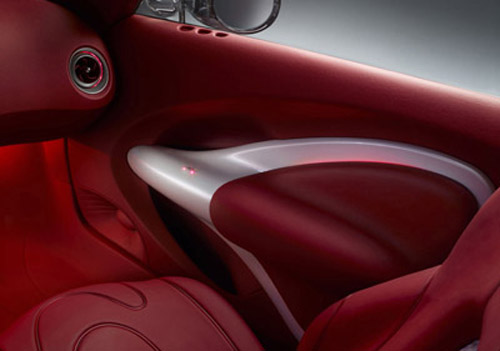
The interior has been designed as an extension of the exterior thanks to a clever interplay between hard and soft materials. Rather than being completely enveloped in leather for example, elements of the lightweight carbon fibre seat structure are on permanent view, appearing to have 'broken through' the covering. The centre portion of the backrests features a mesh material, allowing fresh air to circulate around the occupants.
Like the seats, the metal sections of the centre console seem to have forced their way through the leather covering while the internal door-frame is part exposed so that the door pull appears to be hewn from solid metal.

Motorcycle inspired interior
The way the structure appears through the fabric of the interior also reflects motorcycle design and construction.
Accentuating the practical side of the car, Nissan Qazana Concept has 'floating' seats centrally mounted over a one-piece rubberised floor covering, creating an openness in the cockpit. Grooves cut in the flooring are replicated on the seats themselves.
The dashboard is dominated by a centrally mounted screen. As well as doubling as a navigation display, it will deliver vital information relating to Nissan's next generation fully electronic ALL MODE four-wheel drive with torque vectoring system and other advanced technical processes found on board, including integrated communications systems. Using an intuitive touch-screen interface, the driver will be able to adjust the air-conditioning and other key vehicle settings.

Sunday, June 3, 2012

Nissan 370Z, 2009


  •  Nissan 370Z, 2009
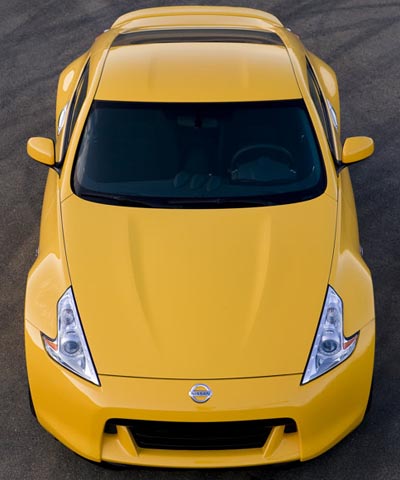
The new Nissan 370Z sports a shorter wheelbase, greater use of lightweight body materials, new engine with more horsepower and a new 7-speed automatic transmission with paddle shifters, as well as the world's first synchronized down/up shift rev control system for the manual transmission.
The full measure of the new model, designated the Nissan 370Z, one need look no farther than the subtle upswept line of the new rear quarter window. Quintessentially Z, the window is reminiscent of the original 1970 Nissan 240Z - a car that revolutionised the sports car world with its unique combination of performance, style and, especially, value. The new Nissan 370Z continues this philosophy, offering accessible performance, true sportscar handling and athletic, agile design.

The New Exterior: More athletic, more muscular, 100% Z.
The 2009 370Z's dynamic new styling offers dual benefits - a more aggressive appearance and a lighter, tighter structure for enhanced performance. The new Z's wheelbase is nearly 100mm shorter than the previous generation Nissan 350Z (2550mm versus 2650mm), accomplished by moving the rear wheels forward in the 2nd generation FM platform, while overall length is reduced by 70mm (4250mm versus 4320mm). At the same time, the overall width been increased by 33mm and the rear track by 55mm.

The more compact exterior dimensions and expanded use of lightweight materials help reduce weight, while at the same time the body structure has been extensively reinforced, improving rigidity.
Along with its new structure and stance, the Nissan 370Z has a taut new skin - one that looks completely new, yet completely Z. The exterior design incorporates intentional 240Z styling cues, a sleek aerodynamic shape, a "dynamic motion" feel with a dramatic cantilevered roof (with Nissan GT-R styling cues) and a "low visual gravity."

The 370Z's sleek silhouette is defined by its upswept quarter window design that is echoed by the dynamic upward curvature in the lower rocker panel and the sense of the taut sheet metal molding itself around the wheels and frame. Attention to detail and functionality is evident throughout the exterior design, including the addition of a turn indicator integrated into the Z logo mounted between the front wheel and door.

The Nissan 370Z Interior: putting the driver at the heart of the action
The interior design of the new Nissan 370Z continues the Z tradition of enhancing driving pleasure, no matter what the road or traffic conditions offer. Additionally, particular attention has been paid to the quality of the material, as well as the fit and finish.
The traditional 2-seat layout is built around a deeply scooped instrument panel with a full-length centre console separating the driver and passenger's seat. In the rear is an open luggage area with enhanced storage and accessibility.
The information layer provides enhanced visibility with easy access to all key data. The gauges are once again attached to the steering column, so the driver doesn't have to choose between the perfect steering wheel position and visibility of the gauges.

The Interior packaging is also enhanced from the previous generation, including the removal of the rear strut brace (replaced with less intrusive structural reinforcements) and by adding a new "shelf" area behind the seats, creating an ideal area for storing briefcases. A retractable cover is standard on the 370Z and locking glove compartment has been added.
Life on board has been improved thanks to the addition of an engine start and stop button, larger diameter dials and thanks to the use of premium-feel material on seats, armrest and door trims (depending on grade).

3.7-litre engine: the Z's heart and soul
As its new moniker suggests, the new Nissan 370Z is now powered by a 3.7-litre VQ37VHR engine with VVEL (Variable Valve Event and Lift). Along with its larger displacement, the new engine gives better power delivery all the way to the 7,000 rpm redline, improved low-end power and more high-end torque, creating an entirely new driving experience. Approximately 35 percent of the engine's parts are new, versus the previous design. Power is rated at 331PS, while torque is 366Nm. Engine output, figures for Europe are subject to homologation.

The new engine is backed by a choice of two new advanced transmissions, both designed to improve driver performance. The newly improved close-ratio 6-speed manual gearbox includes the world's first synchronized down/ up shift rev control system, which allows drivers of any skill level to experience perfectly smooth gear shifts every time. The "SynchroRev Control" function automatically adjusts engine speed when changing gear to the exact speed of the next gear position, essentially "blipping" the throttle to smooth out any down/up shifts.

Saturday, April 21, 2012

Nissan Land Glider Concept, 2009


Nissan Land Glider Concept, 2009

The Nissan Land Glider concept, planners and designers of Nissan have conceived a totally new form of personal zero emission mobility that combines clever, new driving experiences, all in the one compact, 4-wheeled package.

With more than 50% of the world's population living in big cities in the near future, designers latched onto motorcycles as a credible base to start the design process.

While the agility, thrills and freedom of bikes inspired the designers and engineers, an extra spice was added to the mix. Tandem architecture became the obvious choice. A unique two-seater, cocoon-like structure sitting on a zero emission powertrain. With four-wheel stability and a sense of safety that originates from a tilting cabin, the Nissan Land Glider Concept will appeal to both two- and four-wheel driving enthusiasts.

Targeted at city dwellers of all generations, the Nissan Land Glider Concept is a serious motoring statement of the new era of mobility that Nissan intends to lead.

Cocoon in the shell
The exterior incorporates a soft, sleek-looking body that appears to be protected by a special armor, The four-wheeler boasts a dynamic body design that almost seems alive. As part of Nissan's expanding zero emission family, the Nissan Land Glider Concept exudes a clean, friendly attitude."

The vehicle's two-seater tandem layout is enveloped in what seems like the canopy of a glider, while its unique `tilt' setup employs a special leaning function that holds occupants firmly in place even when the vehicle is cornering at angles. In developing the Land Glider, Nissan designers have created a two-seater that offers the sense of security of a cocoon, but delivers real driving pleasure.

Corner and lean
Described as a `personal city commuter,' the Nissan Land Glider Concept features steering-by-wire and a lean capability when cornering ? like a motorcycle ? that enables the vehicle and its tires to lean by up to 17 degrees. Able to turn sharply at nearly any speed, the Nissan Land Glider employs sensors for vehicle speed, steering angle and yaw rate to instantly calculate the level of lean required to negotiate a corner. All the driver must do is turn and the cabin will lean accordingly. By enabling the car to lean, designers have succeeded in minimizing vehicle width and tire tread width, thus achieving a sleek, futuristic look.

Driven by rear electric motors
Two electric motors in the rear powered by lithium-ion batteries mounted beneath the floor, the zero-emissions Nissan Land Glider Concept is quick off the mark. The car also features a non-contact charging system that can be charged whilst shopping at a supermarket or stopping at a motorway service station. This system enables vehicles to be charged cable-less at locations where the infrastructure exists.

Collision Avoidance
To ensure maximum safety whilst driving, engineers have fitted a car-robotics style crash avoidance system in which sensors mounted in the body detect other vehicles in the same way as fish swim in schools without colliding. This system directs the vehicle's path away from any obstacles.

Whilst Nissan Land Glider is a concept car created for the Tokyo Motor Show, it should not be regarded as a mere design study. This leaning machine gives a clear direction to how a future small car from Nissan could look in congested cities...a clue of what Nissan means by new era of mobility.

Technical Specifications
  • Overall Length: 3,100 mm
  • Overall Width: 1,100 mm
  • Overall Height: 1,415 mm
  • Wheelbase: 2,180 mm
  • Seating Capacity: 2

Thursday, April 12, 2012

Nissan Nuvu Concept, 2008


Nissan Nuvu Concept, 2008

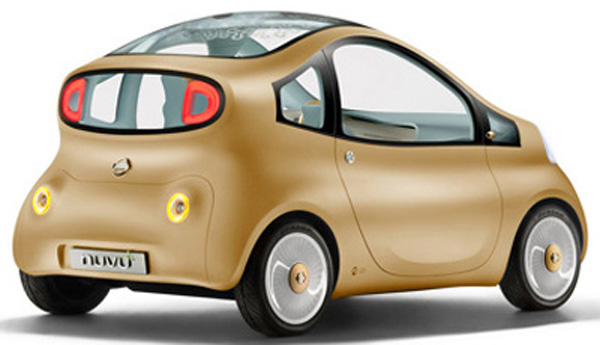
The Nissan Nuvu is a concept vehicle with unique 2+1 seating. It is easy to drive, even easier to park. It is the key solutions for tomorrow's city car."
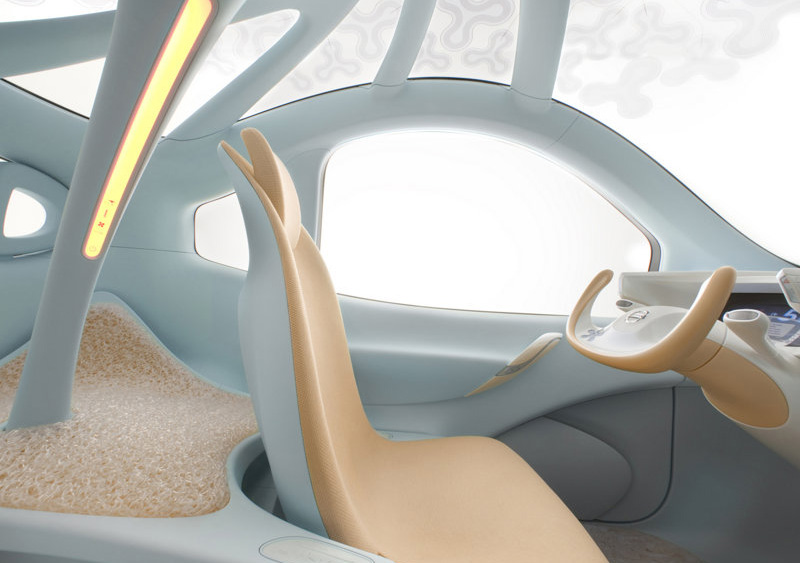
The Nissan Nuvu is described as a moving oasis, a haven of green tranquillity in the urban jungle. To underline this message, Nissan Nuvu incorporates a witty representation of its green credentials: across its all-glass roof are a dozen or so small solar panels. Shaped like leaves on a branch, the power they generate is fed to the battery using a 'tree trunk' within the car as a conduit. Nissan Nuvu also uses natural, organic and recycled materials within the cabin.

The interior package
The dimensions provide all the interior room needed for the vast majority of city journeys. Nissan Nuvu has two regular seats and a third occasional chair that can be folded down when required. But, unlike some two-seater city cars currently on the market, it is a thoroughly practical proposition with an integral luggage area providing sufficient space for a typical supermarket or shopping expedition.

The packaging is designed to give priority to driver comfort with C-segment levels of space and the flexibility to invite one or two passengers on board. Cabin layout places the regular passenger seat beside but largely behind the driver's seat, allowing the passenger to stretch right out. Ahead of this seat is a third occasional chair which, when not in use, is folded away into the dashboard assembly.
But even when the third seat is in use, there remains sufficient legroom for both passengers.
In the interests of saving both weight and space, the third seat has a centre section made from hardwearing yet comfortable netting. This hammock-like approach also has the benefit of allowing cool or warm air to circulate around the occupant's body for extra comfort.
Shopping bags, briefcases and smaller items of luggage can be stowed behind the driver's seat while if the driver is travelling solo, larger items can be stowed in the passenger footwall.

The Natural materials
Many of the materials used inside Nissan Nuvu reflect an increasing concern for the environment. The floor is made from wood fibres pressed into laminate sheets and is studded with rubber inserts made from recycled tyres for grip.
To create a light and bright interior, the windscreen and roof merge into one extended panel running virtually the entire length of the car. But undoubtedly the most unusual feature of the interior is the 'energy tree' which rises from the luggage compartment floor to the roof behind the driver's seat.

The Solar panels
The energy tree is shaped like a thin trunk. As it reaches daylight it branches out under the glass roof providing occupants with protection from bright sunlight… just like a real tree. And providing a visual reminder of Nissan Nuvu's green credentials, covering the branches are dozens of small solar panels shaped like leaves.
The panels absorb energy from the sun which is then fed back down the energy tree and used to help recharge the battery and provide an extra power boost for the electric motor. As well as being genuinely green energy, it is estimated that the power generated via the solar panels will save the equivalent of one full overnight charge from mains electricity each month.

Driver controls are as simple as possible. All the major functions - steering, braking, transmission and throttle - are 'By-Wire' while the steering is controlled by an aircraft-style steering yoke: with just one turn from lock to lock, the steering is very direct for agility and manoeuvrability in the city. Nuvu's turning circle is just 3.7 metres. Thanks to its wide track and the use of 16 inch 165/55 tyres mounted on lightweight, almost transparent, wheels, ride comfort, stability and agility is of the highest order.
There are two pedals - for stop and go - stalks for minor controls and a digital instrument panel with dials for speed, distance covered and battery range.

Rear view/parking monitor
Two screens on the dashboard display the view behind the car - there are no door mirrors to disturb the airflow, but small cameras - and double as monitors for the Around View Camera which give a bird's eye view of the car when manoeuvering or parking.
Saving energy was the guiding force behind the use of low-energy LED head and tail lamps, while Nissan Nuvu's heating and ventilation system filters and cleans the city air as it passes through the vehicle. Not only does it produce no emissions at source, but Nissan Nuvu actually helps clean up the city environment.

The exterior and interior design
Nuvu's design is further clear evidence of Nissan's continued desire to challenge convention and to explore all the possibilities that the EV could bring us. In many ways it was inspired by our two most extreme EVs of recent times: Mixim and Pivo 2.
Significantly, though, Nuvu delivers a more realistic interpretation of two of the most important aspects of its forerunners - the 'Friendly Innovation' found in Pivo 2 and the 'Sports Dynamics' central to Mixim

Matching the ecological values of an electric vehicle, the moulded plastics and synthetic elements found inside a typical production car have been replaced by natural materials and organic alternatives, such as the wood fibres and rubber from car tyres used for the flooring. The result helps create a relaxed, warm atmosphere within Nuvu's cabin.
During the design development stage, key targets were to develop an EV that encompassed obvious modernity with engaging ambience and a playful aspect - hence the energy tree. "You don't need to be a car lover to fall in love with Nuvu," adds Bancon.

EV drivetrain
Nissan Nuvu is more than a styling concept of a future EV. It is a fully working mobile test bed for much of the technology that will be used in Nissan's production EV to be launched in 2010. For this reason elements of its technical specification are being kept secret for the time being.
The electric motor used in Nissan Nuvu is mounted at the rear of the vehicle and drives the back wheels, though neither its exact specification nor the power and torque figures are being released at this stage. A driving range of 125 kms and top speed of 120 km/h are being made public, however.

Li-Ion battery
Similarly although it can be revealed that the batteries used are of the latest laminated lithium-ion type and have a capacity of 140 Wh/kg (watt-hours per kilogram), the total capacity of the batteries and number of modules are not being disclosed at this stage.

Unlike a conventional lithium-ion battery with its bulky cylindrical cells, the laminated Li-Ion battery as used in Nissan Nuvu has thin laminated cells and fewer components overall. This boosts its power by a factor of 1.5 at the same time as halving its physical size. It also remains twice as efficient as a conventional cylindrical Li-Ion battery even after five years or 100,000 kms of continuous usage.
Its compact size allows the batteries to be mounted under the seats and the vehicle's flat floor, thus helping to keep the centre of gravity as low as possible.
A quick charge from empty to full should take between 10 to 20 minutes while a full charge should take between three to four hours from a domestic 220V socket.
Related Posts Plugin for WordPress, Blogger...
Acura, Alfa-Romeo, Alpina, Artega, Ascari, Aston-Martin, Audi, BMW, Bentley, Brabus, Bugatti, Buick, Cadillac, Caparo, Chevrolet, Chrysler, Citroen, Covini, Dacia, Daewoo, Daihatsu, Daimler, Devon, Dodge, Donkervoort, Farbio, Ferrari, Fiat, Fisker, Ford, GM, GMC, Gumpert, Holden, Honda, Hummer, Hyundai, Infiniti, Italdesign, Jaguar, Jeep, KTM, Kia, Koenigsegg, Lamborghini, Lancia, Land Rover, Leblanc, Lexus, Lincoln, Lobini, Lotus, MG, Mansory, Maserati, Maybach, Mazda, Mazel, McLaren, Mercedes-Benz, Mercury, Mindset, Mini, Mitsubishi, Morgan, Nismo, Nissan, Noble, ORCA, Oldsmobile, Opel, PGO, Pagani, Plymouth, Pontiac, Porsche, Renault, Rolls-Royce, Rover, Saab, Saturn, Scion, Skoda, Smart, Spyker, SsangYong, Startech, Stola, Strosek, Torino, Subaru, Think, Toyota, Tramontana, Valmet, Vauxhall, Venturi, Volvo, Wiesmann, Yes, Zagato, Zenvo.