Showing posts with label 2003. Show all posts

Tuesday, January 8, 2013

Buick Park Avenue Ultra, 2003


  • Buick Park Avenue Ultra, 2003

The Park Avenue was Buick's flagship sedan. A luxury trim level, the Ultra (1991), was also available throughout the Park Avenue's run. The Buick Park Avenue Ultra luxury sedan featured a more powerful 205-240 hp supercharged V6 that became standard in 1992 versus the regular 170-205 hp V6. Prices for the Park Avenue ranged from $34,705 for the regular Park Avenue and $39,225 for the Ultra luxury trim.

1997-2005

An updated Park Avenue was released in 1997. Riding on the Buick Riviera's G-body, it was stronger and more substantial than its predecessor. New generations of the 3800 engine continued as the only powerplant, and the Park Avenue continued with minor updates since this date. The Park Avenue was discontinued for 2006 and replaced by the Buick Lucerne. The Lucerne also replaces the nearly identical but smaller Buick LeSabre.

Tuesday, December 11, 2012

MG TF 160, 2003


  • MG TF 160, 2003

A facelift in 2002 saw the MGF rebadged MG TF. The most significant mechanical changes were the abandonment of Hydragas suspension in favour of conventional coil springs, the new design of the air-induction system that along with new camshafts produces more power than in MGF engines, and the increased by 20% tortional stiffness of the body. Various cosmetic tweaks including a revised grille, redesigned front headlights, bumpers, side air-intake grills, rear boot, etc. The MG TF was the first car of its class to be awarded a leading 4-star safety performance from EURONCAP.

The MG TF was proving reasonably popular in comparison with the best affordable sports cars. However, production was suspended in 2005 when MG Rover collapsed. Nanjing Automobile Group, which bought MG Rover's remaining assets during bankruptcy proceedings, plans to restart production of a redesigned MG TF in Longbridge and in Ardmore, Oklahoma, in early 2007. For the first time the MG TF will become available to U.S. car buyers.

When it became apparent that MG Rover no longer held the rights to its 25 and 75 models, the company's administrators, PricewaterhouseCoopers, believed the MG TF to be the company's most valuable remaining asset.


Monday, November 5, 2012

Hummer Humvee Military Vehicle, 2003


  • Hummer Humvee Military Vehicle, 2003

The M998 High Mobility Multipurpose Wheeled Vehicle (HMMWV or Humvee) is a highly durable military motor vehicle. It has largely supplanted the role formerly served by the Jeep and other light trucks with the United States military, and is also used by a number of other countries and organizations.

Features
There are at least 17 variants of the HMMWV in service with the United States armed forces. HMMWV serve as cargo/troop carriers, automatic weapons platforms, ambulances (four litter patients or eight ambulatory patients), M220 TOW missile carriers, M119 howitzer prime movers, M-1097 Avenger Pedestal Mounted Stinger platforms, MRQ-12 direct air support vehicles, S250 shelter carriers among many others. It is capable of fording 2.5 ft (76 cm) normally, or 5 ft (1.5 m) with the deep-water fording kit installed.

Optional equipment includes a winch (maximum load capacity 6000 lb. (2700 kg)), and supplemental armor. The M1025 and M1043/M1044 armament carriers provide mounting and firing capabilities for the MK19 grenade launcher, the M2 machine gun, the M240G machine gun and M249 SAW. The newly introduced M1114 "up-armored" HMMWV also features a similar weapons mount. Recently, there is also a new type of the HMMWV introduced featuring a CROWS (crew served optical weapons station), which lets the machine gunner operate from inside the vehicle.

History
In the 1970s, the United States Army concluded that the militarized civilian trucks in use no longer satisfied their requirements. In 1977, Lamborghini developed the Cheetah model to attempt to meet Army contract specifications. In 1979, the Army drafted final specifications for a High Mobility Multipurpose Wheeled Vehicle, or HMMWV. In July of that year, AM General began preliminary design work, and less than a year later, the first prototype, the M998, was in testing.

In June 1981, the Army awarded AM General a contract for development of several more prototype vehicles to be delivered to the U.S. government for another series of tests, and the company was later awarded the initial production contract for 55,000 HMMWVs to be delivered in 1985. HMMWVs first saw combat in Operation Just Cause, the US invasion of Panama in 1989.

They have become the backbone of U.S. forces around the world. Over 10,000 were used during Operation Iraqi Freedom by U.S. forces as well as some other countries during the 2003 invasion of Iraq.

One US Humvee was captured by the Yugoslav Army during the Kosovo war and is currently on display in front of the Military Museum building on Kalemegdan Fortress Park, Belgrade, Serbia.

In Operation Iraqi Freedom, the Humvee has proved vulnerable to IED. As of early 2006, total losses were at 250 Humvees. One Humvee was destroyed in the 2006 Israel-Lebanon conflict killing the three IDF soldiers inside and led up to the two captured IDF soldiers, it was hit by a Hezbollah rocket propelled grenade

Usage in Iraq and political implications
The HMMWV has proven very vulnerable to light infantry weapons as far back as the Somalia intervention; in its defense, it was never designed to offer such protection. With the rise of asymmetric warfare and low-intensity conflicts, the HMMWV has found itself thrust into urban combat roles it was not originally intended for. Although the large variety of HMMWV types is a testament to the vehicle's adaptability to changing mission conditions, it was never designed to be an armored personnel carrier (APC).

As it is not an armored vehicle, HMMWVs are very vulnerable to rocket propelled grenades and offer the troops within little protection from small arms fire. Although there are several armor kits available for the vehicle which afford it greater protection from small-arms fire, these were not provided in great numbers to American forces in Iraq prior to the invasion. As a result of this, American soldiers and Marines often improvise extra armor layers with scrap materials (also known as "hillbilly armor") to improve the safety of the HMMWV. While "hardening" or "up-armoring" their vehicles with sandbags, metal, and plywood does make the vehicles arguably safer, it also slows them down. It has also been argued that hardening simply creates more shrapnel when attacked with an RPG or improvised explosive device. This extra hardening further hampered the ability of the M998 and M1025 due to the addition of excess weight which overloaded the suspension and drivetrain components of these HMMWVs. Performance issues due to the high center of gravity and extra weight of up-armoring kits increase the risk of sway and rollover. Unlike similar-size civilian cargo and tow trucks, which typically have dual rear wheels to reduce sway, the HMMWV has single rear wheels. The independent rear suspension coupled with the body design may preclude "dually" fitment which is the standard for solid-axle trucks of that weight range.

In response to the perceived vulnerability of HMMWVs operating in Iraq, the U.S. Department of Defense contracted AM General to make the M1114 Uparmored HMMWV. The M1114 has been in limited production since 1996 and had seen limited use in the Balkans before deployment to the Middle East. This design has a larger, more powerful engine with a turbocharger, air conditioning and a strengthened suspension and boasts a fully armored passenger area protected by hardened steel and bullet-proof glass. With the increase in direct attacks and guerilla warfare in Iraq AM General has diverted the majority of its manufacturing power to producing these vehicles.

In December 2004, Secretary of Defense Donald Rumsfeld came under criticism from U.S. soldiers and their families for not providing better equipped HMMWV. Rumsfeld pointed out that, prior to the war, armor kits were produced only in small numbers per year. As the role of American forces in Iraq changed from fighting the Iraqi Army to suppressing the guerrilla insurgency, armor kits were being manufactured as fast as additional production facilities could be brought online. Armor aggravates the severe inherent performance limitations of a light truck with independent suspension, but it does offer improved protection. Other countries experienced in urban war such as Russia and Israel rely on tracked armored personnel carriers, but the wheeled HMMWV fits current anti-track sentiment among Army senior leadership as exemplified by the Stryker and other wheeled systems.

Weaknesses
As an unarmoured vehicle it is vulnerable to about any weapon capable of hitting it. As a primary threat, RPG's can penetrate and thus completely annihilate an HMMWV. As a secondary threat, AK47-fire reportedly sometimes makes it to the inside, and is still capable of wounding passengers. This is mostly when the 7.62 mm bullets are fired from a short distance, and is also depending where exactly the vehicle is struck. Besides fire from foot-soldiers, it is also very vulnerable to road side bombs (IEDs and land mines), as proven in Iraq. The armor on most up-armored humvees holds up well against lateral (from the side) blasts when the blast is distributed in all different directions, but runs a greater risk of a mobility or catastrophic kill when struck by a blast from beneath. Also the person mounting the machine gun on the top of the vehicle is extremely vunerable to enemy fire.

Replacement
The US government is seeking a replacement for the AM General truck, and the U.S. Army's Tank and Automotive Command is currently refereeing a prototype competition. Navistar International and Lockheed Martin are participating, while AM General has not been selected. The Navistar entry is based on their International CXT line, and this truck has already been prototyped to replace the HMMWV for non-military use by the U.S. Department of Homeland Security, Department of Defense, and Border Patrol.

The Marine Corps is also looking into replacements for the HMMWV. The Office of Naval Research is funding Georgia Tech's ULTRA AP, a combat concept vehicle based on the F350 chassis, but with a radical "blast bucket" passenger compartment, and Ultra 3T, a project with more advanced (but unproven) technologies.

Humvee replicas
Due to the popularity of the Humvee, there have been kits produced for building a humvee-replica yourself. The kits do not allow you to build a humvee from scratch (kitcar), they do allow you to rebuild a sedan to a humvee-lookalike, alternatively one can also just buy a preconstructed (or turnkey) wombat. Various kits probably exist, but the most famous is the "Wombat" (-or previous HummBug). The former vehicle can be purchased for $18,000.00, considerably cheaper than the actual Humvee ($56,400.00), or Hummer.

Wednesday, August 1, 2012

Hummer H3T Concept, 2003


  • Hummer H3T Concept, 2003

The Hummer H3 is a vehicle from General Motors' Hummer division, introduced in 2005. The H3 is the smallest of the three Hummer models, and though the H3 concept car was a pickup truck, the final vehicle is a conventional SUV. Its GMT345 platform is based on the GMT355 which underpins the Chevrolet Colorado and GMC Canyon pickup trucks. Built on a modified Colorado/Canyon pickup truck frame (with more crossmembers and more frame boxing), the H3 shares many major components with its siblings.

The H3 is built at GM's Shreveport, Louisiana factory. Export versions will also be produced at the General Motors South Africa facility in Struandale, Port Elizabeth, South Africa.

In the American market, the H3 is priced from $29,500 to just under $40,000. Sales have been strong, with the 33,140 sold in 2005 making up 58% of Hummer's total sales for the year. For the first two months of 2006, 8,071 H3s were sold, 74% of all Hummer sales.

Specifications
The H3 uses the 3.5 L (3464 cc) Atlas straight-5 engine.The same engine that is used in the Chevrolet Colorado/GMC Canyon pickup trucks. This 20-valve DOHC unit produces 220 hp (164 kW) at 5600 rpm and 225 ft·lbf (305 N·m) at 2800 rpm. It is available with a 5-speed manual or 4-speed automatic transmission that includes GM's Stabilitrak vehicle stability control. Its 111.9 in wheelbase is 1.1 in shorter than the GMT360 SUVs. It includes an electronically-controlled dual-speed transfer case and electronic locking differential.

Since it is rated at less than 8500 lb (GVWR), Hummer is required to provide official fuel economy ratings. It is rated at 16 mpg in the city cycle with both transmissions and 19 mpg with the automatic or 20 mpg with the manual on the highway. While the Hummer H2 will ford 20 inches of water, the H3 will handle 24 inches of water (it has been tested in depths up to 31 inches). The H3 is the only vehicle in its class to have a 2-speed transfer case standard.

Tuesday, June 5, 2012

Hummer H2 with GM Accessories, 2003


  • Hummer H2 with GM Accessories, 2003
The H2 is the second vehicle sold under the Hummer marque of General Motors. It is a large SUV (though smaller than the Hummer H1) with room for five passengers and substantial off-road ability. The rearmost part of the H2 SUV was modified to a pickup truck bed for the 2004 H2 SUT ("Sport Utility Truck").

Overview
The H2 is built under contract by AM General at a specially constructed plant in Mishawaka, Indiana, USA. Although it shares GM's GMT820 truck platform with the Chevrolet Tahoe and GMC Yukon, those vehicles differ in many ways and are constructed in three other GM plants. The H2's final frame assembly is made up of 3 sections: The front uses a modified GM 2500-Series utility frame, the mid-section is all new and is completely boxed, and the rear section uses a modifed GM 1500-Series frame which is upgraded for the 8000 pound (3629 kg) gross vehicle weight.
The H2 was nominated for the North American Truck of the Year award for 2003.

Engine
2003–2005 6000 6.0 L (366 in³) V8

Capabilities
With its high ground clearance, large tires, protective underbody plates, and low gearing, the H2 is capable of climbing over a 20-inch-high (0.4 m) step-up wall. A massive truck frame and wide track offer stability against overturning compared to some of the more common light truck SUVs, although objective tests have not been performed by the government or other outside parties due to its specialised vehicle class.

Fuel economy
For typical travel on improved roads, users report fuel economy of between 10 and 14 miles per gallon, which converts to between 14 and 17 L/100 km. Worst case urban driving is said to be in the range of 8 to 14 U.S. mpg (21 to 25 L/100 km). Although General Motors does not provide official H2 fuel economy ratings, most reviews have observed high single to low double-digit mileage, similar to the numbers above.

It should be noted that other large vehicles also have poor fuel economy especially with optional larger engines including the Dodge Ram 1500 series pickup trucks equipped with either the 8.3L V10 (MSRP US$48,500) or the 4.7L V8 Flexible Fuel engine running E85 fuel (MSRP US$31,300). Both of these engines are rated at 9 U.S. mpg city and 11 U.S. mpg highway by the E.P.A. as one example.

Criticism
The Hummer H2 is one of the most severely criticized civilian vehicles on the market today. Critics have expressed concern at the fuel economy which they cite as being among the most inefficient of vehicles. The Environmental Protection Agency does not test them for fuel economy because of their weight, they are thus categorised as light trucks and thus are not bound to fuel economy standards.

The Hummer H2 is criticised for contributing towards petroleum comsumption in the United States. In addition, they are criticized for obstructing the views of drivers behind them with their large vehicles. Criticism is also leveled at the H2 by safety advocates who have expressed concern that their size and height make them far deadlier to smaller vehicles as well as bicyclists, and pedestrians since the front of the Hummer H2 will likely strike the head and/or chest where injuries are far more life-threatening instead of the knees where regular cars are most likely to impact a pedestrian.

Tax benefits
Under the United States income tax code, the cost of vehicles over 6,000 pounds (2722 kg) can be deducted from income. This deduction was enacted decades ago to assist self-employed people in purchasing a vehicle for business use. The weight minimum was intended to limit the deduction to commercial-type trucks. For many years, the deduction remained below the average cost of a new vehicle, since large trucks were relatively inexpensive. Since it is a reduction in taxable income, the actual value of this deduction averages 30% of the price of the vehicle in question.

The increasing popularity of these vehicles in the last decade, however, pushed their average price to nearly double the average passenger car cost. In response, the 2002 Tax Act increased this "Section 179 depreciation deduction" to US$75,000, and it rose again to US$102,000 for the 2004 tax year. This is more than three times the current average cost of a passenger car in the United States and covers a large number of luxury models, including the Hummer H2. In late 2004, the deduction was again reduced to US$25,000.

Wednesday, April 18, 2012

Lexus LX470, 2003

 
 Lexus LX470, 2003

The Lexus LX is a full-size luxury sport utility vehicle sold by the Lexus division of Toyota. Also, it was Lexus's first SUV. It has a 4.7-liter, four-cam V8 engine with four valves per cylinder. The LX has a welded steel body and a capacity to seat eight passengers. The LX replaced the Toyota Land Cruiser for the Canadian market, because most automobile companies (except for GM, Ford and Chrysler) could not sell rebadged models in Canada, the real reason being that big expensive SUVs do not fare well with Canada. Thus, having a Land Cruiser and LX470 in the same market makes matters worse.

The LX470 shares the same floorplan and most body panels with the Toyota Land Cruiser. The current LX470 differs from the Land Cruiser only in its front optics and a more luxurious interior.

Recently, Toyota made it clear that the next LX will be completely different from the Land Cruiser. Because there isn't space for two similar SUVs in the North American market. The LX's repalcement will most likely be smaller but more luxurious than the upcoming Land Cruiser. Hence directly competing with the Range Rover.

2003 upgrades

For the 2003 model year, the Lexus LX470 received an interior refesh, new grille, redesigned wheel rims and a 5-speed gearbox (an upgrade from the previous 4-speed gearbox).

2006 upgrades

For 2006, the engine's output was increased 45 hp, boosting the total output to 275 hp. The engine provided VVT-i (variable valve timing). New LED rear taillamps, a new grille and redesigned wheel spokes were added.

Monday, April 16, 2012

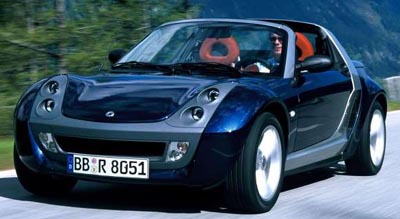
Smart Roadster, 2003


Smart Roadster, 2003

Smart Roadster
The Smart Roadster is a two-door microcar first introduced in 2003 by Smart GmbH. Unfortunately, sales of the Roadster and Roadster Coupé were far below expectations, resulting in a halt of production of both models in November 2005.

The History
At the 1998 Paris Motor Show, the two-seat, 2.5-metre Smart City Coupe (later named Smart Fortwo) was launched. This was the beginning of a new car brand and one of the more radical vehicle concepts to hit the European market since the bubble cars of the 1950s. It was also the beginning of a difficult period for Smart. The City Coupe had stability problems that were uncovered only immediately prior to launch. These forced a package of alterations to be made that were both expensive and compromised the car’s handling, ride and gear shift. Public concerns over the car's stability, combined with Smart’s elitist marketing and the sheer radicality of the car’s design, proved damaging to initial sales. Production projections were slashed from 200k per year to 80k, close to disastrous for a new brand with just one product.
Inside the company, the evangelical buzz surrounding the launch of the radical City Coupe quickly evaporated. With new management, new marketing initiatives and continuing revisions to the car’s engineering to answer pulic concerns, future vehicle plans, including development of a four-seat model, had not been far advanced. It was under these inauspicious circumstances the Smart Roadster was born.

The Design & Development
Under design director Jens Manske in autumn 1998, Smart's 14-strong design and engineering team began to sketch possible future Smart cars. They soon realised that the powertrain of the City Coupe was ideal for a small sports car, with a compact turbo engine driving the rear wheels via a sequential 6 speed gearbox.

Following Smart’s ‘reduce to the max’ philosophy and general innovative approach, a concept for a super compact, practical and pure sports car was generated. Two quarter-scale exterior and two quarter-scale interior models were made in February 1999 with Volker Leutz’s exterior and Christoph Machinek’s interior proposals selected for development into full-size development models. The design of the car had progressed considerably by the time Michael Mauer officially arrived from Mercedes Benz's Japan design center to take over Menske's position in May 1999. Mauer worked closely with the design team to quickly develop the roadster, with the intention now of producing a show car for the upcoming 1999 IAA motor show in Frankfurt.

By June the full size models of the roadster were handed over to Stola in Italy for production of the show car model, which was produced in about three months for the car’s debut at the Frankfurt show. The Roadster concept was well received at Frankfurt and helped to convince management that the car should be developed for production. At the same time a decision was made to develop Mauer’s idea for a coupe version as a concept car for Paris motor show a year later. As development of the coupe concept began, so the roadster show car was developed over the following year with both exterior and interior designs completed by November 2000 However, colour and trim design continued until a year later.

By early 2000 the Smart City Coupe had finally started to gain sales momentum, with its cabrio version making a significant addition to total Smart sales. In March Mauer left Smart for Saab, succeeded by Hartmut Sinkwitz in May. As the third design director of Smart during the Roadster's development, Sinkwitz had to bring the concept to production in a very short time. This task may have been made somewhat easier by the Roadster having been designed from the start to use existing powertrain and other City Coupe components. Given some of the advanced design features, it is a credit to the design team that so much of the concept car made it to production.

The Concept Car
the ‘Roadster Coupe’ as shown at the 2000 Paris motor show was already on its way to production form. It shared the design of the Roadster from the doors forward, but had a glass targa roof and rear structure resembling a very small estate (station wagon) in the same way as the BMW Z3 coupe and the Saab 9X concept car developed under Mauer at Saab a few years later.

Production versions of both Roadster and Roadster Coupe debuted together at the 2002 Paris Motor Show and were available to buy within a few months. Both cars were unique in the market, being significantly smaller that the Toyota MR2, MG TF, Fiat Barchetta and Mazda MX5, but offering similar performance and practicality to the base versions of these cars while significantly more fuel efficient.

Production
The Smart Roadster and Roadster Coupé were introduced in 2003, based on a stretched platform of the Fortwo (full length is 3427 mm). The two variants are meant to be reminiscent of the British roadster of yore, such as the Triumph Spitfire or the MG B. Both the Roadster and Roadster Coupé are available with a removable Targa roof or an electrical Softtop. The Roadster is powered by 45 or 60 kW (61 or 82 PS) versions of the turbocharged 3-cylinder engine in the rear, which is engineered by Mercedes Benz. The Roadster Coupé has only the more powerful 82 PS engine. A steering wheel with Formula 1-style gearpaddles, to control the semi-automatic sequential transmission, is optional. With weight as low as 790 kg, it is meant to provide the emotion of driving a sports car at an affordable cost. Still, the Roadster's price is not very far from that of a Fiat Barchetta or Mazda MX-5.

Both the Roadster and Roadster Coupé are available in Brabus-tuned versions with power increased to 74 kW (101 PS). The Brabus versions have a different twin sports exhaust, lower suspension, polished six-spoke aluminum alloy Monoblock VI 17" wheels, front spoiler, side skirts and radiator grille. Exclusive Brabus interior includes leather trimmed dashboard, alloy-effect accent parts, instrument graphics, leather/aluminium gearknob, aluminium handbrake handle, aluminium pedals and Brabus labeled floor mats.

Thursday, April 12, 2012

Noble M12 GTO 3R, 2003


Noble M12 GTO 3R, 2003

In 2000, the Noble M12 GTO threatened to turn the established supercar market on its head. With its mix of scorching performance, race-bred dynamics and immaculate build quality, the Noble could be bought for a fraction of the cost of most of its rivals, but gave away nothing to them on the road and track. The press raved about it and demand rapidly grew as buyers saw this British-designed car as a credible alternative to cars costing more than twice the price.

The original Noble M12 GTO was fitted with a 2.5-litre V6 engine using twin turbochargers and produced 310bhp (314PS) - enough for it to accelerate from 0-60mph (0-97kph) in 3.9 seconds and 100mph (160kph) in 9.4 seconds (figures from Autocar magazine). As if this wasn't fast enough, at the start of 2003, Noble upped power further by replacing the 2.5-litre unit with a 3.0-litre V6 engine, again with twin turbochargers, but this time producing 352bhp (357PS).

There are currently two models in the range: the M12 GTO-3 and the M12 GTO-3R. Both cars use the same engines and underpinnings, but there are significant differences in styling, refinement and transmissions. The M12 GTO-3 is the entry model in the range, with a list price of £47,950. As with the GTO-3R, it has a GRP composite body over a spaceframe chassis offering impressive levels of structural and torsional rigidity. Inside, the cabin is spacious enough to accommodate people over six-foot tall and has excellent ergonomics, adjustable seats and steering column, a fully trimmed safety roll cage and Alcantara trim as standard.

At a list price of £49,950 the M12 GTO-3R is visually identifiable from the GTO-3 by its faired-in twin bi-xenon headlights and Noble-designed ten-spoke alloy wheels. Inside, the 3R has extra noise insulation and full leather trim as standard. But what really sets the 3R apart from the 3, is its all-new Getrag-Ford six-speed gearbox and Quaife Automatic Torque Biasing differential, enhancing its appeal as both a relaxed, high-speed GT and an accomplished track day weapon.

The ENGINE & TRANSMISSION
The 2968cc, twin-turbocharged V6 used in both Noble models is transversely mounted in front of the rear axle, directly behind the cabin. It features four valves per cylinder and double overhead cams to each bank of cylinders. The all-alloy engine is heavily modified from standard, with many bespoke components fitted during build. It produces 352bhp (357PS) at 6200rpm, and is redlined at 7200rpm.

On the road, 350lb ft (475Nm) of torque produced between 3500 and 5000rpm makes the car immensely flexible and easy to drive. Even at 3000rpm, the engine is producing 80 per cent of its available torque. There's also very little lag from the twin Garret T25, water-cooled turbochargers, meaning a particularly linear response throughout the rev-range. The turbochargers run a maximum 0.7 bar of boost and are equipped with an air to air intercooler, centrally mounted at the rear of the car.

A completely new design of exhaust for the 3.0-litre engine gives you the choice of enjoying the sporty engine note under hard acceleration, or savouring the V6's inherent refinement at cruising speeds.

The all-new Getrag-Ford six-speed manual gearbox, standard on GTO-3R models, has closer intermediate ratios than the GTO-3's five-speed gearbox, but has an even more relaxed top gear than before, running 26.5mph per 1000rpm. This means that at 70mph the engine is turning over at a mere 2650rpm.

Also standard with the GTO-3R's six-speed gearbox is a Quaife Automatic Torque Biasing differential. This unique, patented unit shares the basic characteristics of a conventional limited slip differential, which prevents loss of drive when one wheel starts to slip. However, the ATB differential has the advantage of gears, rather than plates, which can wear or break, and therefore servicing is reduced and reliability improved. The ATB also eliminates much of the understeer that is inherent in conventional LSDs, by transferring more torque to the driven wheel that needs it most, rather than it being split equally between both wheels; this prevents the rear wheels trying to push the front wheels wide when cornering.

CHASSIS, SUSPENSION & STEERING
Both M12 models use bodies made from GRP, under which lies an all steel space frame with bonded and riveted alloy panels; the total weight for the GTO-3 is extremely light, with a kerbweight of just 1050kgs, while the GTO-3R adds an extra 30kgs, due to better soundproofing. Continuing the race-bred theme is double wishbone suspension all round, with alloy uprights and Bilstein shock absorbers.

A key element of the Noble M12's success has been its ability to combine fine on-road dynamics with safe and predictable handling on a race circuit. A hydraulically power assisted steering rack, with 2.6 turns from lock to lock is quick enough to make fast-road or track driving rewarding, yet comfortable enough when small corrections are needed on the motorway. The M12 also has a very supple ride over a wide range of surfaces, meaning that it's an entirely practical proposition for everyday use. Yet incredibly, it can be driven on a race circuit with hardly a trace of body-roll, and remains composed and controllable at very high speeds.

Servo assisted, four-piston calliper brakes with ventilated discs (330mm diameter front, 326mm diameter rear) are fitted all round and both cars wear 225/40 ZR 18 tyres at the front and 265/35 ZR 18s at the back.

INTERIOR & EQUIPMENT
Both the GTO-3 and the GTO-3R come as standard with a fully trimmed safety roll cage, race harnesses (in addition to inertia reel belts), a leather Momo steering wheel and adjustable seats and steering column. The 3R adds a full leather interior, a Sony CD/tuner with column mounted remote control, an engine start button and fitted leather map pockets.

For a full list of equipment and options, please see the accompanying Noble brochure.

PERFORMANCE
There are few cars in the world that accelerate as quickly as the Noble M12 GTO-3 and the Noble M12 GTO-3R. Not only do they both have massive traction off the line, thanks to their mid-engine design, but they also have potent levels of torque from low down in the engine's rev-range. This means that there is practically no 'lag' before the turbochargers start working, making the Noble a particularly effortless and easy car to drive fast.

Auto Express magazine tested the Noble GTO-3R and achieved the following set of acceleration figures using Racelogic satellite-driven timing equipment at a private test facility.
  • 0-60mph (0-97kmh) 3.7 seconds
  • 0-100mph (0-160kmh) 8.8 seconds
  • 30-70mph (48-113kmh) through gears 3.2 seconds
  • 30-50mph (48-80kmh) in third gear 2.0 seconds
  • 40-60mph (64-97kmh) in fourth gear 2.5 seconds
  • 50-70mph (80-113kmh) in fifth/sixth gears 3.5/6.1 seconds
Top speed 170mph
Braking from 60mph (97kmh) 38.2 metres

Tuesday, April 10, 2012

Pagani Zonda C12-S Roadster, 2003


Pagani Zonda C12-S Roadster, 2003

The Pagani Zonda is a supercar made by Italian car maker Pagani. It debuted in 1999 and continues through the present, with production proceeding at roughly 25 cars per year. As of December, 2005, 60 Zondas had been built. It is a mid-engined 2-seat coupe and convertible. Construction is mainly of carbon fiber.

Some early Zonda engineering was done by Formula One champion, Juan Manuel Fangio. The car was originally to be named for him, the "Fangio F1", but the name was changed upon his death in 1995.

The Zonda is often compared to other supercars such as the Enzo Ferrari, the Koenigsegg CCR, the Lamborghini Murcielago and the Porsche Carrera GT.

1999 Zonda C12
The C12 debuted at the 1999 Geneva Motor Show. It was powered by a 6.0 L (5987 cc) Mercedes-Benz M120 V12 engine and could reach speeds of 185 mph (297 km/h). The engine produces 408 PS (300 kW/402 hp) at 5200 rpm and 421 ft·lbf (571 N·m) at 3800 rpm.

Just five of the original 6.0 L Zondas were built, though it was still available in 2002 when the C12 S debuted. One was used for crash testing, while another was a demonstrator and show car. The rest were delivered to customers over the next three years, priced at US$320,000.

The C12 could accelerate to 60 mph (97 km/h) in 4.2 seconds and hit 100 mph (161 km/h) in 8.2 seconds. Acceleration through the quarter mile was 12.1 seconds at 124 mph (200 km/h). Lateral acceleration on the skidpad was .93g, and the car could brake from 60 mph (97 km/h) in 110 ft (34 m).

1999 Zonda C12 S
The C12 S used a 7.0 L (7010 cc) AMG tuned version of the engine producing 550 PS (404 kW/543 hp). It can accelerate to 60 mph (97 km/h) in 3.7 s, to 100 mph in 9.5 s and complete the quarter mile in 11.9 s. Lateral acceleration on the skidpad is 0.98 g (9.6 m/s2). The car is 10 kg (22 lb) lighter than the normal Zonda C12. Top speed is 220 mph (354 km/h) for the coupe and 215 mph (346 km/h) for the roadster. The car's price tag was US$350,000.

The C12 S features an elongated nose and flaps at the rear for improved aerodynamics. New light clusters and exhausts are also used. Fifteen 7.0 L C12 S cars were produced.

2002 Zonda C12 S 7.3
The 7.3 L (7291 cc) C12 S 7.3 of 2002 used one of the largest V12 engines ever made. The engine was designed and manufactued by Mercedes-Benz AMG. Traction control was added to handle the 555 PS (408 kW/547 hp) and 750 N·m (553 ft·lbf) that this engine produces. As of 2005, only five coupes out of an expected 100 have been produced.

A roadster version is also built, with production limited by the company to 40 examples. As of 2005, nine roadsters had been built. According to Road & Track magazine, three more C12 S 7.3 cars had been built as of June, 2005, but it is unclear whether they were roadsters or coupes. Motor Trend reported that 60 Zondas of all types had been built in their January 2006 issue.

2003 Zonda GR
Development of the Zonda GR started in December, 2002. At this stage the Zonda was nearly four years old, but had yet to be entered in major motorsports. Tom Weickardt, owner of American Viperacing, Toine Hezemans, owner of Carsport Holland, and Paul Kumpen, owner of GLPK, created a new company, Carsport Zonda, to build a racing version. They secured exclusive rights to develop, build and sell competition Zondas from Horacio Pagani, and the first GR was completed at Carsport's facility in Modena within months.

The Zonda GR is based on the Zonda C12 S. It was built on the same carbon fiber chassis, with tube frames in front and back. The bodywork was modified to include front and rear diffusers and louvers for improved aerodynamics. The car was 2 m (6.6 ft) wide, in accordance with the regulations of the FIA and ACO. The car's weight was reduced to 1100 kg (2425 lb), and a new suspension was designed. New wheels and brakes were also specified. The engine was equipped with an enlarged radiator, and the engine and gearbox also have new oil coolers.

The performance of the Zonda GR is well beyond that of the stock car. The car sprints from 0 to 60 mph (97 km/h) in 3.3 seconds and the engine produces around 600 PS (around 440 kW) at 5800 rpm and 580 ft·lbf (786 N·m) of torque at 4300 rpm with a redline increased to 7500 rpm. The added power and improved aerodynamics allow the car to hit 215 mph (346 km/h).

C12 S Monza

The Zonda C12 S Monza debuted at the 2004 Paris Motor Show as a track-day version of the Zonda for private use. Borrowing its appearance cues from the Zonda GR, the Monza included many features which could also be applied to other Zonda models. A dry sump engine tuned to more than 600 PS (more than 440 kW) was used, and the cooling was improved. Modified aerodynamics, including a different wing and front diffuser, allowed greater speed, as did optimized gearing. The car was lighter, with polycarbonate side windows, and an unmuffled exhaust is fitted. The revised interior includes different pedals, steering wheel, and seats, as well as a reinforced roll cage. Larger brakes and a stiffer suspension also improve performance. Finally, an external fire extinguisher is included for safety.

2005 Zonda F (C12 F)

The Zonda C12 F debuted at the 2005 Geneva Motor Show. It is the most extensive reengineering of the Pagani car yet, though it shares much with its predecessors including the 7.3 L V12. Power is increased to 602 PS (443 kW/594 hp) with a special clubsport model producing 650 PS (478 kW/641 hp). The company promises a 3.2 second sprint to 60 mph (97 km/h, a top speed over 350 km/h (218 mph) and it will be the queen in braking from 300 km/h to 0 (186 mph to 0). The Zonda F clubsport has a power to weight ratio of 521 bhp/ton (384 W/kg) . Compare, for example, the Enzo Ferrari which has a power to weight ratio of 483 bhp/ton (356 W/kg).

Production of the Zonda F will be limited to 25 cars, still not US compatible. The next model, due to be unveiled in 2008, will be fully EPA/DOT compatible.

The Zonda F, named after F1 pilot Juan Manuel Fangio, comes with an extra head light and different fog lights at the sides, new bodywork (revised front end, new rear spoiler, more aerodynamic vents all around) that improves the cars aerodynamics and different side mirrors. Further enhancements over the 'S' centre around optional carbon/ceramic brakes developed in conjuction with Brembo, magnesium wheels, inconel titanium exhaust system, hydroformed aluminium intake plenum and a redesigned 'Z preg' weave in the crash structure to improve rigidity and reduce weight.

Zonda Roadster F
The Zonda Roadster F debuted at the 2006 Geneva show. It is similar to the coupe, but with a removable carbon fibre roof and canvas side curtains weighing just 11 lb (5 kg). Production of the Roadster F is suggested at 25 units.

The Roadster F is able to maintain chassis rigidity without any gain in curb weight by eschewing conventional thinking by not strengthening the sills - a process which would have needed more than 35kg of reinforcement. Pagani instead uses racecar thinking, materials and construction techniques, strengthening the firewall structure of the chassis tub together with billet alloy braces that connect the points where the roof rails would have joined. The windscreen is also strengthened for safety reasons. These techniques enable the Roadster to have virtually the same weight as the coupe - 1230kg.
Related Posts Plugin for WordPress, Blogger...
Acura, Alfa-Romeo, Alpina, Artega, Ascari, Aston-Martin, Audi, BMW, Bentley, Brabus, Bugatti, Buick, Cadillac, Caparo, Chevrolet, Chrysler, Citroen, Covini, Dacia, Daewoo, Daihatsu, Daimler, Devon, Dodge, Donkervoort, Farbio, Ferrari, Fiat, Fisker, Ford, GM, GMC, Gumpert, Holden, Honda, Hummer, Hyundai, Infiniti, Italdesign, Jaguar, Jeep, KTM, Kia, Koenigsegg, Lamborghini, Lancia, Land Rover, Leblanc, Lexus, Lincoln, Lobini, Lotus, MG, Mansory, Maserati, Maybach, Mazda, Mazel, McLaren, Mercedes-Benz, Mercury, Mindset, Mini, Mitsubishi, Morgan, Nismo, Nissan, Noble, ORCA, Oldsmobile, Opel, PGO, Pagani, Plymouth, Pontiac, Porsche, Renault, Rolls-Royce, Rover, Saab, Saturn, Scion, Skoda, Smart, Spyker, SsangYong, Startech, Stola, Strosek, Torino, Subaru, Think, Toyota, Tramontana, Valmet, Vauxhall, Venturi, Volvo, Wiesmann, Yes, Zagato, Zenvo.